Redcaps and Redthroats: ‘shrooms and loons…
…on the northwest Oregon coast.
 It’s not very much like the Sonoran Desert here. Everything’s either wet or damp, and when it rains it’s not a pounding monsoonal deluge that ends quickly, but a steady long-term soaking, which might last hours, days, or the rest of the year. Things that live here are water-loving organisms, like Loons and Mushrooms.
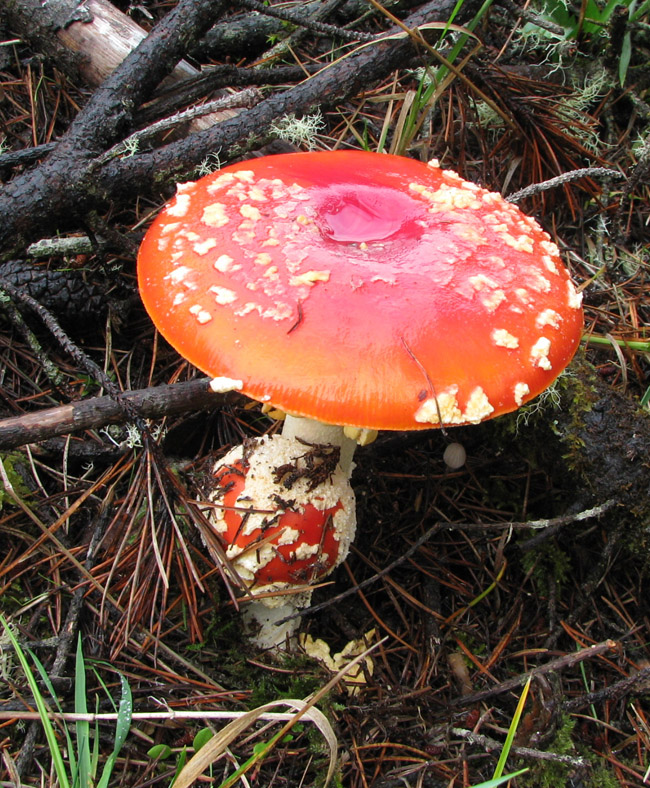
E got great photos of some of the numerous – and poisonous – Fly agaric mushrooms (Amanita muscaria) pushing up through the evergreen needles on Clatsop Spit. There were other varieties of fungus in abundance too, little brown guys with caps so transluscent their gills showed through, and big slick yellow ones with a slime sheen on top. As well as fungi, the moist forests had sprouted mushroom hunters galore: some with five gallon plastic buckets topped with edible varieties, perhaps chanterelles.
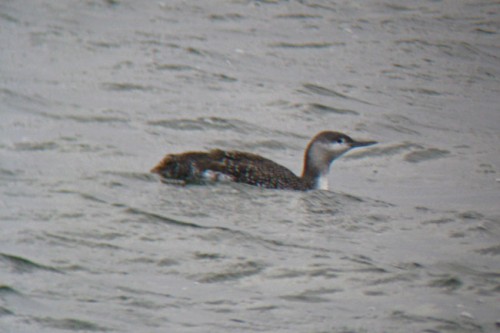 Less colorful but still nice to see were an assortment of loons: Common, still sporting a bit of their black-and white summer plumage; a juvenile Pacific loon with its silvery neck; and a pair of Red-throated loons close to shore (left), with their distinctive pale tip-tilted bills, and backs whose pattern looks like the texture on a manhole cover.
Fortunately, sea birds and waders are out in all weather, so even on the wind-whipped estuaries and rain-lashed beaches, there are things to see, like this distant dotted line of Brown pelicans speeding 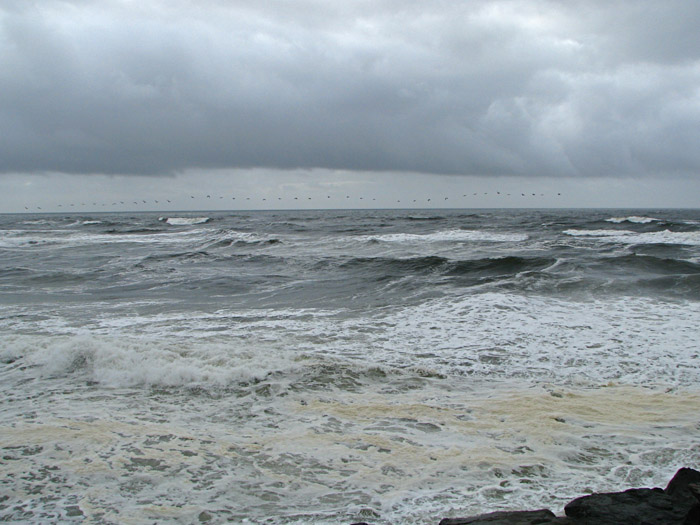 down-wind on a gale at the South Jetty at Fort Stevens State Park.
(Top photo: Fly agaric mushroom, E.Shock; middle: Red-throated loon, only adequately digiscoped by A.Shock; stormy Pacific coast with brown pelicans, A.Shock)
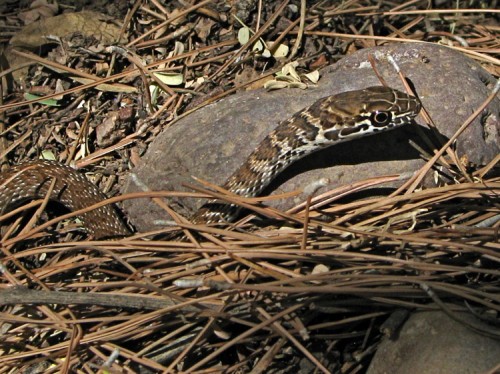 This handsome youngster and I surprised each other under the hummingbird feeder in the palo verde, and it held still enough for long enough that we were able to get some photos. I suspect it was after young
 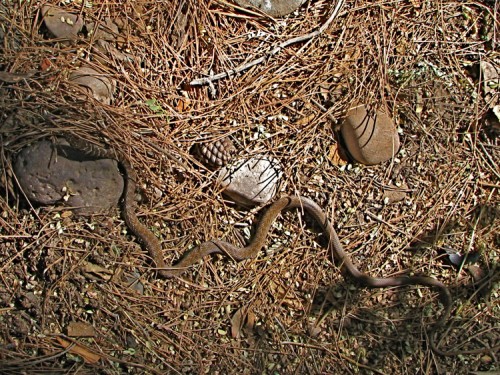 Coachwhips (Masticophis flagellum) lay their eggs in June and July, and the young begin to maraud in August and September. So this well-camouflaged youth is probably a month or two old, and already a whippy thin 13 or 14 inches in length.
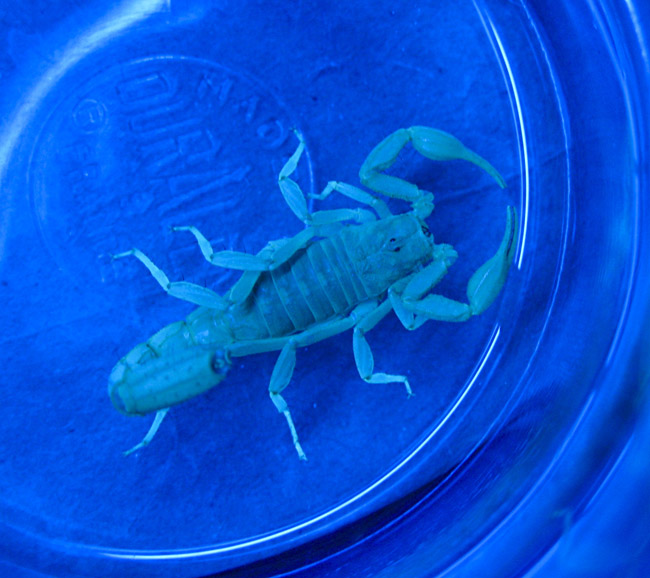 In the morning, I wanted to watch it glow. Here’s a picture of it viewed under a UV light, with the glass’s Duralex logo for scale. It’s another “striper”: Vaejovis spinigera, a stripe-tailed scorpion, our most common species.
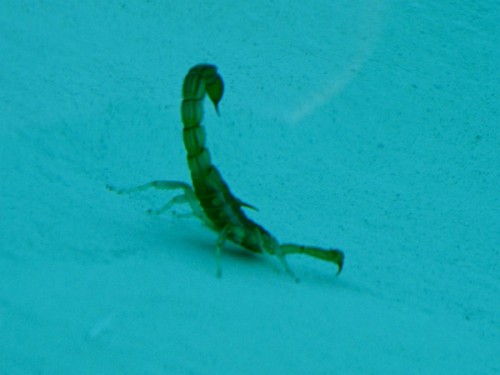 Unfortunately, not everything that takes the inadvertent plunge is so lucky, and daytime critters often fare better than nocturnal ones, because I see them, and can help. So, often, the first thing I do in the morning is check the pool for watery unfortunates: the closer to the surface, the better: the bottom, not so good. Most days, there’s nothing. But one morning, I was surprised to see this Striped-tailed scorpion (Vaejovis spinigerus) standing on the side of the pool about 18 inches below the surface (the infrequent drowned scorpion we encounter is generally on the bottom, belly up). The poor thing must have fallen in and, unable to get out, found itself a place to stand ready for anything, with its tail fully armed, and stuck there until it expired. I fished it out, and took some pix for reference, and left the soft, waterlogged body for something to make a meal of. I never saw what scored it — probably cactus wren or thrasher — but it didn’t take long; less than an hour later the little body was gone.
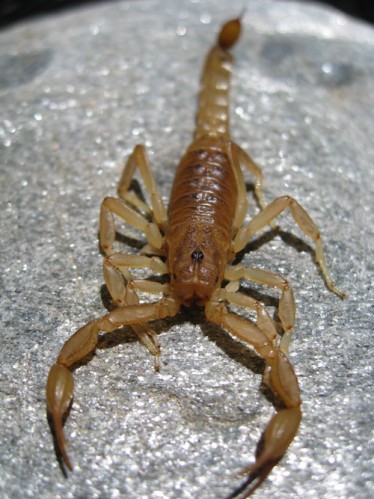 Here’s a close-up of it, eye-to-eye, a view we don’t often see of these close to the ground tiny arthropods. If you’re wondering how this mildly venomous stingy thing differs from the more venomous stingy-thing, the Bark Scorpion (Centuroides spp.), the thicker, bulbous tail with longitudinal stripes on each section is the easiest characteristic to note. The Bark scorpion has a much thinner, more gracile tail and pincers, and often holds its tail coiled to the side.