payday loans

Archive for the 'increments' Category

You are currently browsing the archives of Three Star Owl – Functional and Sculptural Clay Artwork with a Natural History .

Not my hen

Anna’s hummers are capable of setting clutches just about year round in warm climate states like Arizona and California.  The little males have been doing their combo territorial and courtship dives — which culminate in a loud, popping “CHEEP” sound since December, at least in our neighborhood.  This little Hen in Tucson has gotten a bit of an early start to her reproductive year: here’s a digiscoped shot (acceptable if not perfectly sharp) of her on her fresh nest >>

I was visiting Kate‘s house in Tucson on my way back from Wings Over Willcox, when the motion of the tiny busy hen happened to catch my eye as she flew up into her nest with a beakful of some sort of light-colored fibers to add to the construction.  Mature Aleppo pines seem to be a favored nidification tree for Anna’s, where nests are often built on top of the smallish pinecones, as in this case.  I wish her luck, and I hope there’s not too much more winter weather for her to sit tight through!

(Photo A.Shock)

Posted by Allison on Jan 18th 2012 | Filed in birds,close in,hummingbirds,increments,natural history,nidification | Comments (0)

Moonshots

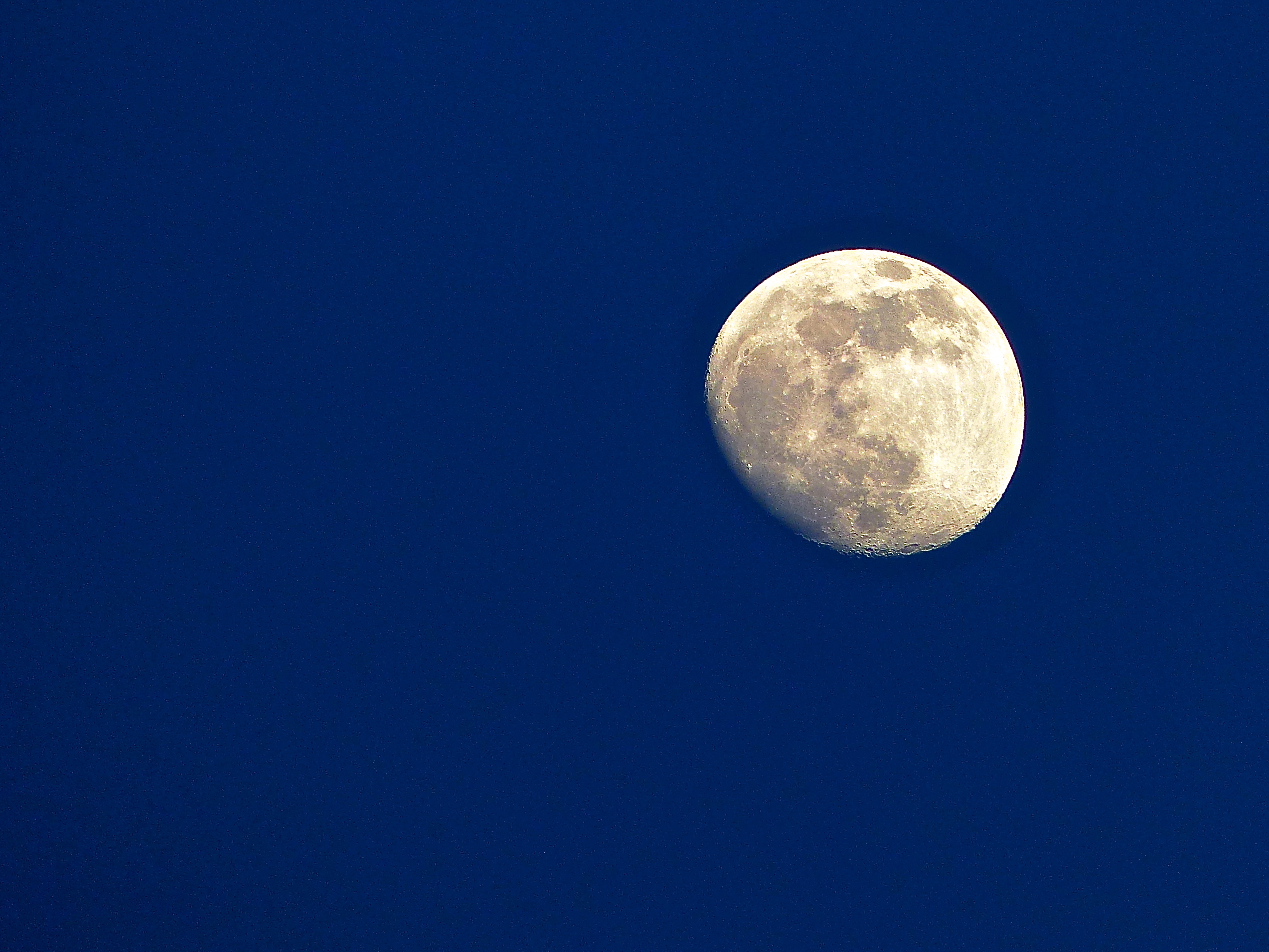
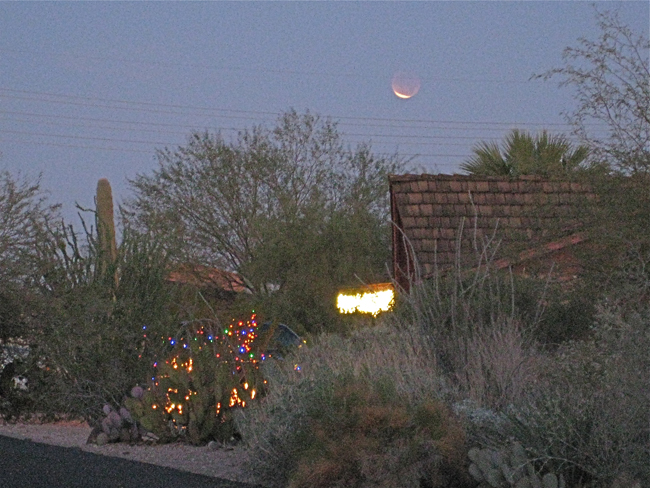
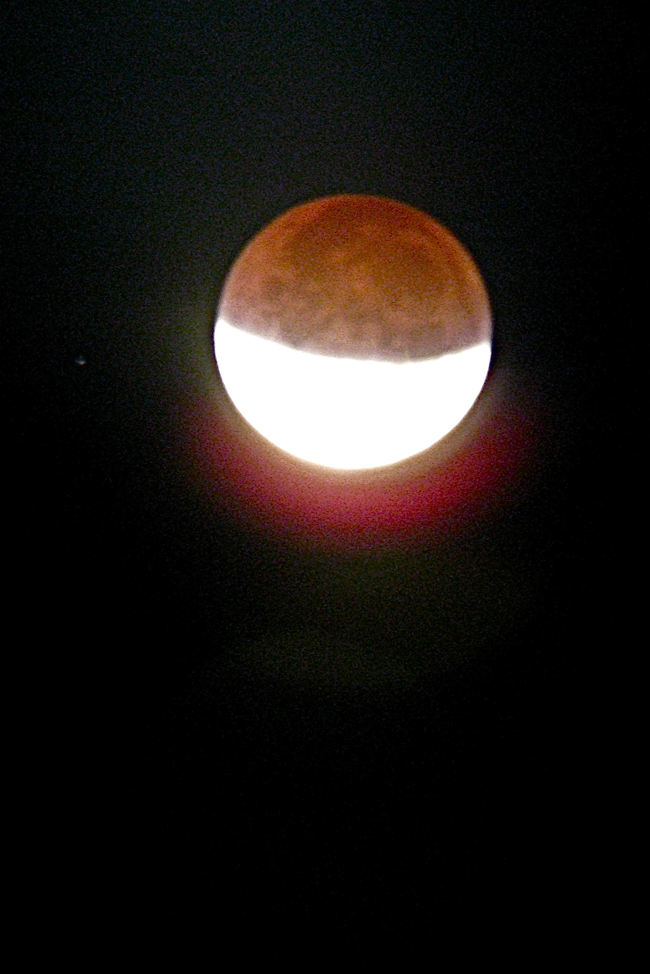
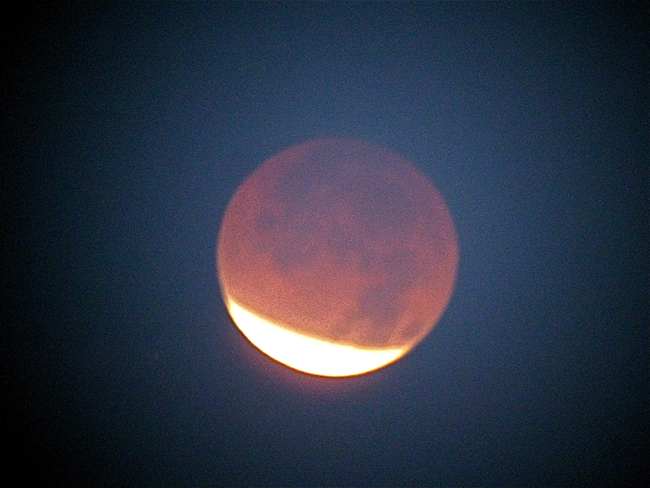
Here’s the total lunar eclipse from the Phoenix area this morning, just before totality.  The desert skies were clear, so that we had a wonderful dark sky view of the first half of the event.  But totality began right at sunrise, so just as the whole moon was shadowed, it sank in a sky too bright to see the light reappear along the upper rim.  Still, it was spectacular!  Above, just digital zoom on a Canon Elph; below, digiscoped on a 50mm Nikon Fieldscope.  (All photos A.Shock)

Posted by Allison on Dec 10th 2011 | Filed in increments,natural history,yard list | Comments (2)

Another Potter

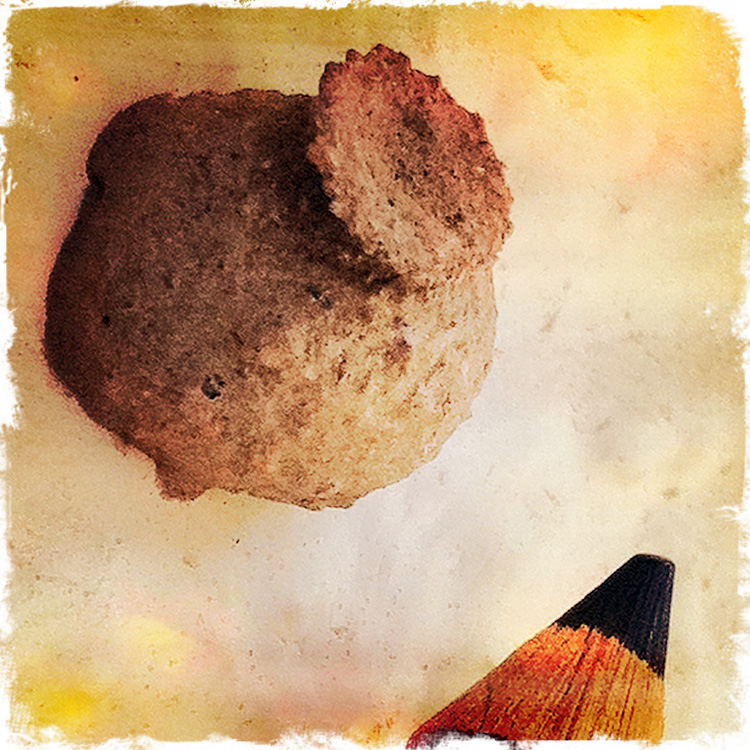
Here’s a slightly arty image of an un-opened Potter Wasp nest on the front wall of our house, with a drawing pencil for scale.  Click here for more info on what these tiny clay pots are, and why the wasps build them.  One of these days, I hope to be in the right place in the right time, and see the new wasp break out and fly away.

(Photo A.Shock)

Posted by Allison on Jul 30th 2011 | Filed in close in,cool bug!,increments,Invertebrata,natural history,yard list | Comments (2)

New out of the box

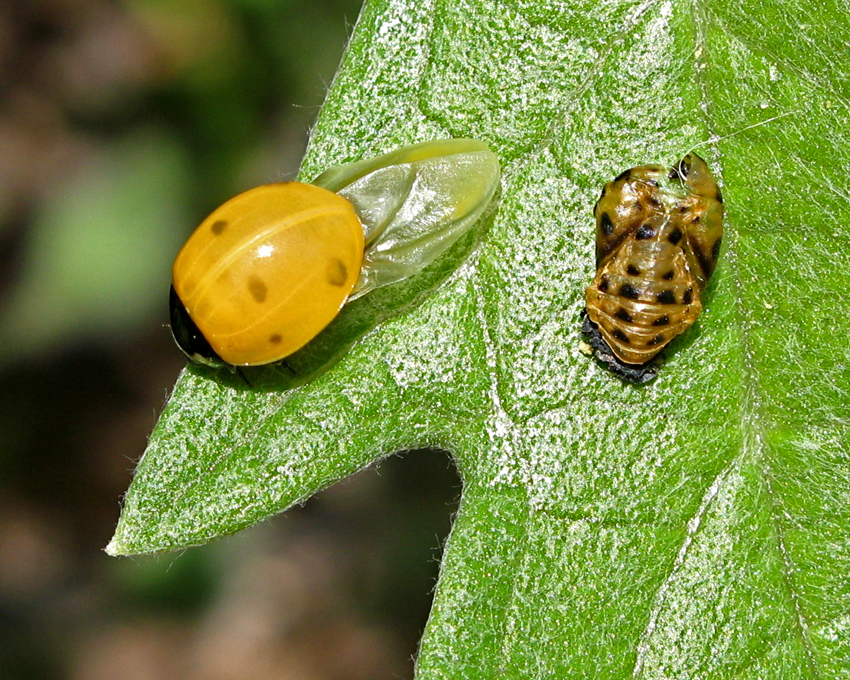
Though the lady bug life cycle has been covered here before, I can’t resist posting this photo of a brand new Lady Bird Beetle and its recently exited pupal casing.

>> the bug and the box it came in. Click to enlarge, it’s a nice big file (photo A.Shock).

Just a couple of days ago, I’d noticed the pupa on an artichoke leaf in the veggie garden. It was practically the first evidence I’d seen of the spring lady bug generation’s progress since finding the eggs on the cilantro earlier this month. Later, I’d only managed to find one active larva, so I was pleased to locate this pupa. Sunday morning I went to show it to E, and there it was — split open now, while its erstwhile occupant, having backed out of the crack in the posterior of the casing, pumped its new flight wings full of hemolymph in the bright morning sun. The unripe-tomato-y quality of the elytra at this stage is perfect, starting out transluscent waxy-yellow and slowly deepening to the familiar cherry-tomato red. The spots appear and darken gradually like darkroom images, gaining contrast and intensity as the carapace dries and hardens.

The Hidden Egg

This time of year the world is pregnant with nests full of eggs, tiny cottontails hopping and hiding in the yard, fledgling birds following their parents food-begging insistently, new yellow-green leaves and catkins on the mesquite trees, and glorious cactus blooms.

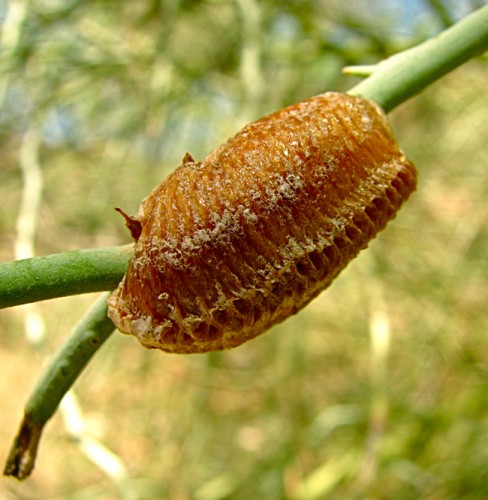
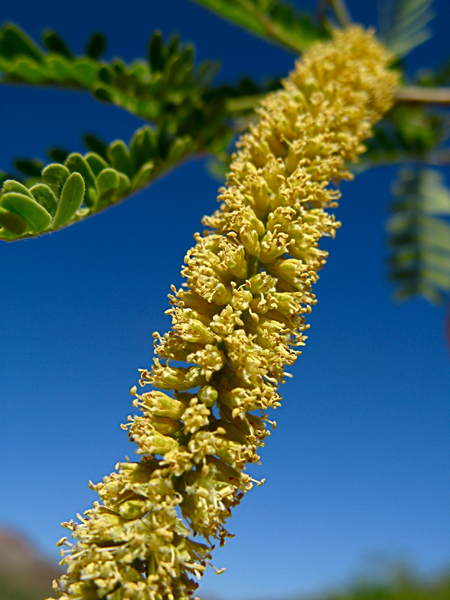
<< Praying mantis egg-case on a Palo Verde twig (photo E.Shock). >> close-up of a mesquite catkin (photo A.Shock)
But as this acceleration of generation increases, we see another side of abundance: broken eggs on the ground, young birds not experienced enough to stay out of the street, small mammals learning the hard way about the swimming pool, an adult gopher snake swallowing a tiny cottontail.

Spring is a scavenger’s prime-time. We’ve been watching an Inca Dove carcass decompose under the tangerine tree. In the dry desert, this isn’t a grisly thing: if not enjoyed by raccoons, foxes, or feral cats, the soft parts are quickly consumed by the local scuttling scavengers, usually ants or dermestid beetles and the like. Inca Doves are small, anyway — there’s not much to them, and small bodies don’t have time to bloat, liquefy, or smell very much.
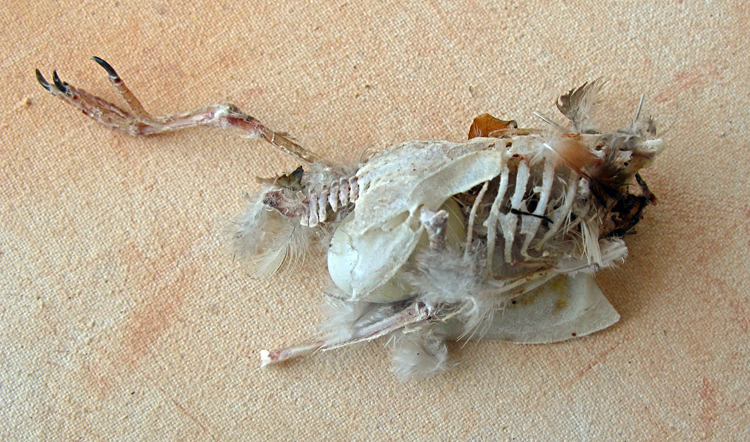
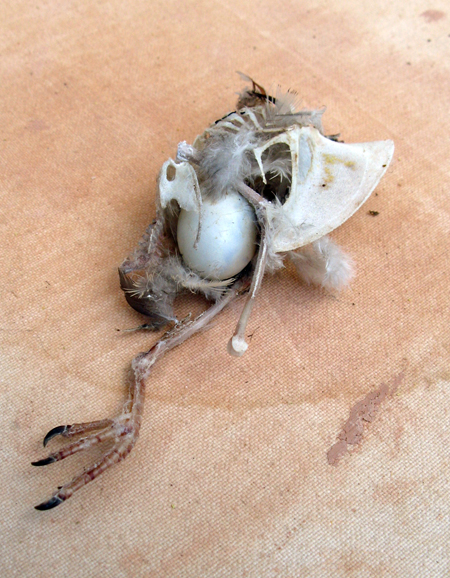
>> Inca dove skeleton (photo A.Shock)

Decomposition is short and if not sweet, at least efficient. What was an intact dove carcass lying in the leaf litter a couple of days ago was, by yesterday, an articulated partial skeleton. The head was gone, but the ribs were still festooned with a few feathers, and the pelvis dangled two femurs and a foot. The ants’ tidy de-fleshing revealed a possible cause of death invisible to us before: egg-binding. Look below the rib-cage under the vertebrae and pelvis, and you can see an intact egg, cracked but still heavy with its contents, in place in the abdominal cavity.
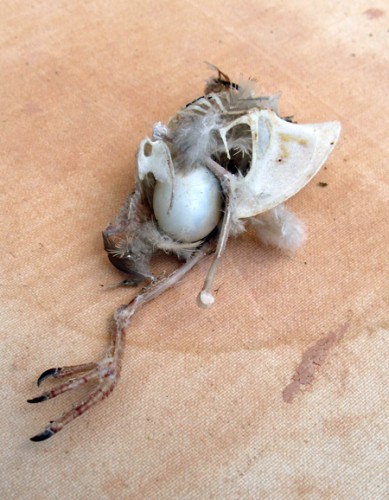
<< Here’s a side-view. The large blade-shaped bone on the right is the little dove’s keel, or breast-bone; the egg sits snugly — perhaps a little too snugly — under the tiny pelvis.

I don’t have my own photo of an Inca Dove — although they’re common in our yard, they’re camera-shy, at least in my experience. But if you need the reassurance of a living image, or more info about Inca Doves, click here, for the Cornell Lab of Ornithology entry on the species.

And just to sweeten the pot because after all it is the holiday season, here’s a photo I posted last spring, of two terribly tiny bunnies snuggled into the form their mother scraped out for them. Go ahead; click to enlarge to see their tiny fluffy details. It was either this or one of the gopher snake eating a baby cottontail, but I think I’ll save that for next Easter.
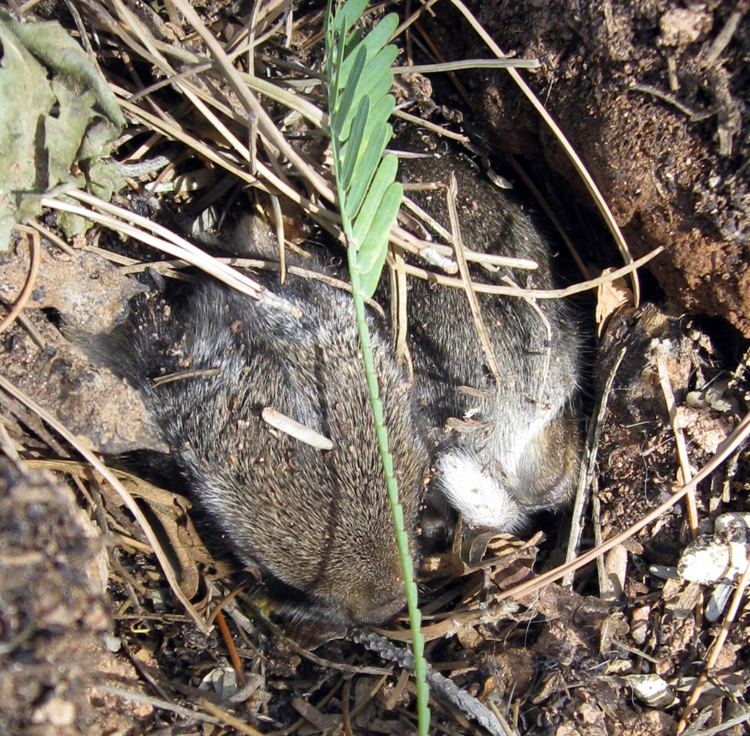
>> two infant cottontails stashed in a form (photo A.Shock)

Heretofore missing eggs

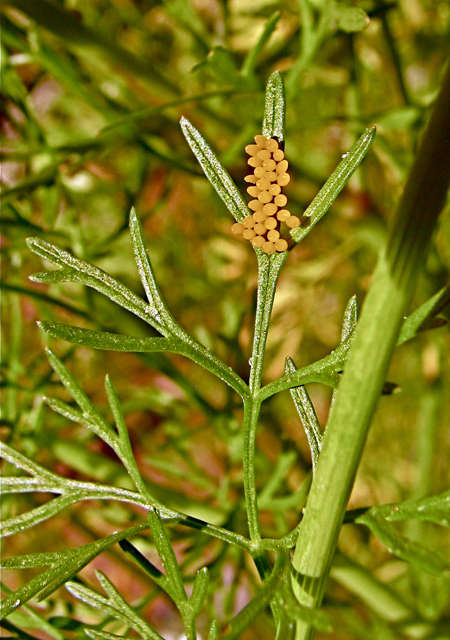
Last fall our herb garden hosted a successful crop of parsley, cilantro, and Lady bird beetles (AKA Lady bugs).  But we only noticed the bounty of bugs when we found roving hordes of hungry beetle larvæ voraciously devouring hapless aphids.  Pictures of the process of larval metamorphosis were captured  and posted here, but all the eggs had already hatched, leaving the beginning of the adventure undocumented. Now the cycle has begun again, and happily this time we caught it from the start.

>>Here are lovely saffron-colored lady bug eggs on our bolting parsley, awaiting transition into fearsome predatory eating machines. (Thanks to E for the photo.)

We’ll have to be careful when we harvest for tabbouleh!

Where are the Owl Hives?

The Owl Hives are in Chandler.

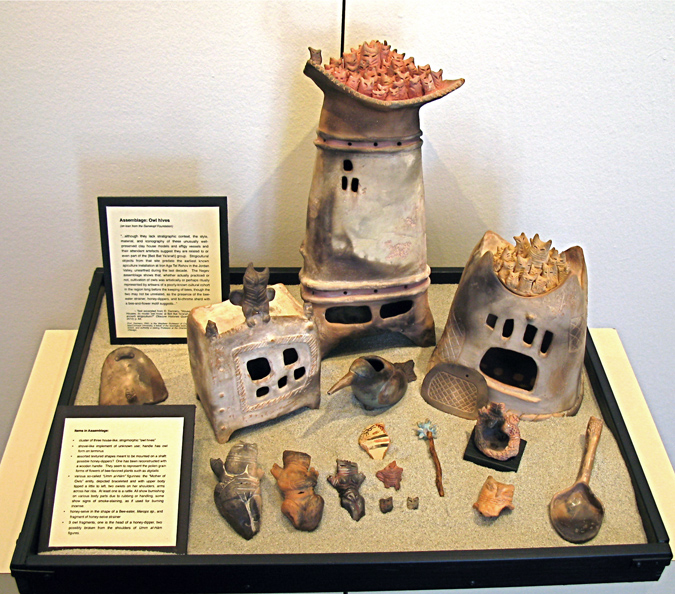
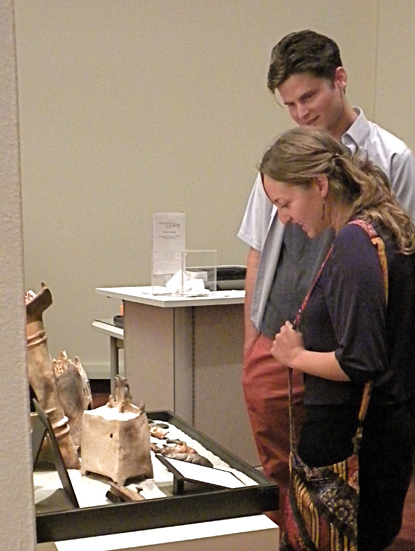
On Friday night, March 18, the All AZ Clay Invitational Exhibition opened at the Chandler Center for the Arts, displaying the work of more than 40 clay artists from all over the state of Arizona.  Among them is an installation of artefaux by me, entitled Assemblage: Owl Hives.

>> Assemblage: Owl Hives (photo and piece, A.Shock 2011)

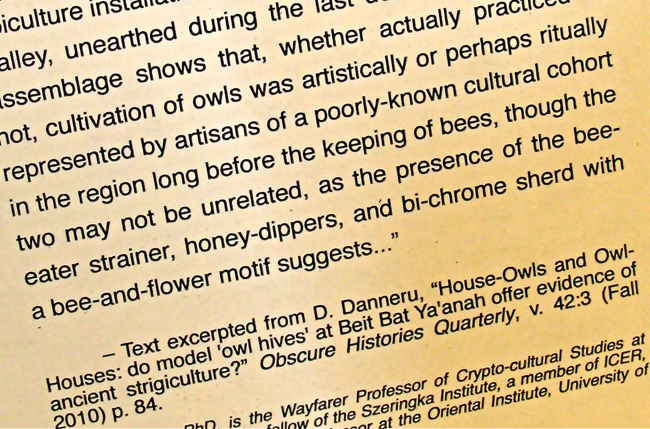
The piece is composed of a variety of related, archeologically-themed elements, and is intended to be viewed on its own æsthetic merits.  But, if you read this blog regularly, parts of the installation will look familiar to you, since I’ve posted bits and pieces of it before, in progress.  Also, in the Assemblage, you may recognize a tie-in to the fictional posts that appear here irregularly: according to the signs, the piece is purported to be on loan from the august but mysterious Ganskopf Foundation.  In addition, the ubiquitous and insinuating Dr. Darius Danneru has graciously provided an excerpt from a recent article, supplying authoritative and scholarly, if prolix, context for the piece.  <<

I hope you can stop by the Chandler Center for the Arts’ Vision Gallery anytime before April 16, when the show closes, to see what the Arizona clay community is up to, including three pieces by Don Reitz, from the CCA’s collection.  More info below, or click on Three Star Owl events(Photo E.Shock>>)

Exhibition Dates, Hours, and Location:

March 18 – April 16, 2011
Vision Gallery Hours: Monday – Friday, 10 am – 5 pm, Saturdays, Noon – 4 pm
at: Chandler Center for the Arts
MAP/Directions
250 North Arizona Avenue
Chandler AZ 85225
For more information call 480-782-2695.

Hen Triumphant!

We’ve been watching a hummingbird Hen — we think she’s an Anna’s (Calypte anna) — on a nest since the middle of February.  Lots of people have passed close to her chosen spot, which was fairly low in a crooked Aleppo pine in our backyard, right over a gravel path through the side of the garden.  There was a big wind storm, and chilly late-winter temperatures.

>> Hummingbird nestling (photo A.Shock; click to embiggen)

But the Hen kept sitting, and we finally saw the results of her diligence: one slightly fluffy, fairly well-grown chick peering out over the edge of the small cup-like nest (see photo above).  There’s going to be one more influx of people in the next couple of days to try its courage.  But at least the weather is warm now, and many more flowers are blooming, including some recovered chuparosa flowers, so when the new little bird fledges, there should be lots of nectar and gnats to learn on.

And, for those who follow this blog regularly, I believe I forgot to mention here the last appearance of the unusual (for Phoenix) male Broad-billed hummingbird in our yard last month.  He stuck around until the 16th of February, and we haven’t seen him since.

In other hummingbird news around the yard, yesterday, March 14, we saw our first-of-season Black-chinned hummingbird (Archilochus alexandri) at one of the feeders.

<< Black-chinned hummingbird magnet (Three Star Owl/A.Shock)

Or rather, saw and heard: the males’ wings produce a whirring zizzz in flight: usually we hear them in the yard before we see them.  These hummers are slender, and the males have a black head which shows a purple swash at the bottom edge along their neck, but only if the light is just right.


Posted by Allison on Mar 15th 2011 | Filed in birds,close in,hummingbirds,increments,natural history,nidification,yard list | Comments (2)

I know where the Hen she sits…

…and also why it’s called “Broad-billed”.

Although those two statements concern two different birds.

Update: as of Friday morning, “Bill”, the Broad-billed hummingbird, is still reporting in to our backyard feeders, passing the 72-hour mark (I first observed him on Monday afternoon).  We guess he’ll be here until he’s not!

Breeding season for Anna’s hummers is in full swing here in Phoenix.  The males are executing their showy flights, shrieking down from a height with their gorgets flashing scarlet, making a loud peeping pop with their tail feathers like tiny bullroarers, then rising vertically upward to do it again and again, usually targeting a perched female to impress her with this routine.

<< Anna’s hummer on current nest in Aleppo pine (click to enlarge; all photos A.Shock)

And from my studio I’ve been watching a female Anna’s gathering spider webs and flying away with her beak wrapped in gossamer, a sure sign of “nidification,” otherwise known as nesting.

When our trees were trimmed last week, we searched hard beforehand to make sure there were no current nests in the trees affected, and didn’t find anything. However, late this afternoon, while scanning for the errant Broad-billed hummingbird who has been working our feeders, I did find a nest, just by luck: I saw the Hen fly up into a low pine branch, and stick.  Binox showed me a little beaky head above an apparently completed nest, built above a pine cone on a nearly horizontal branch.  From everyone’s perspective, it’s not a great spot: it’s fairly low over the path through the part of our yard we call the Sonoran Garden, and E could (and probably unintentionally will) bump the branch with his head as he walks by. To me it seems a very exposed location.  In fact, while I was watching her, the Broad-bill zoomed up and perched on a smaller branch just inches below the nest with hen, apparently unaware of her.  She knew he was there: she froze, and waited perfectly still until he went away, which was soon — he’s a restless body.

>> Male Broad-billed hummer, out of place, out of season, but he’s been here for 48 hours, that we know of.  (Click to enlarge.)

The Broad-bill flew a short distance away and settled on a preferred perch in the “ugly” lemon tree.  Although the photo isn’t perfectly sharp, you can see that the base of his bill is slightly flattened, making it look broad, especially in comparison with the needle-like rest-of-the-beak.

Incidentally, for the first time ever, the normally prolific “ugly” lemon tree set one whole lemon as its entire crop this season, and it dropped that during the tree-trimming episode.  So as far as I’m concerned the shirking citrus can bear the burden of a tiny colorful bird as its tangy winter crop for a while longer.

Posted by Allison on Feb 9th 2011 | Filed in birds,close in,hummingbirds,increments,natural history,nidification,yard list | Comments (2)

Next »