Archive for the 'archaeology' Category

You are currently browsing the archives of Three Star Owl – Functional and Sculptural Clay Artwork with a Natural History .

What happened at Beit Bat Ya’anah: part 15

This is the latest installment of the series. The following links will take you to the last episode before this one, and the very first episode of the series:

Read Part 14 ………………………………………………………………….For new readers: Read Part 1

Previously:

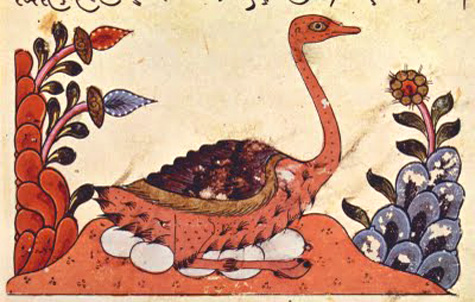
Having extended her time at Beit Bat Ya’anah to try to learn more about Szeringka’s elusive protégé, Einer Wayfarer also continues to gather info about the site itself. “Beit Bat Ya’anah means House of the Ostrich’s Daughter,” Amit Chayes had told her. “There used to be an ostrich farm on the site. Ask Moshe sometime – he loves to tell that story.” Since the professor now finds herself dreaming about herds of strong-toed ostriches wandering freely among the jumbled rocks of the Upper Wadi, she resolves to ask Moshe about this part of the site’s history.

Moshe’s tale part 1: hai bar and hospitality

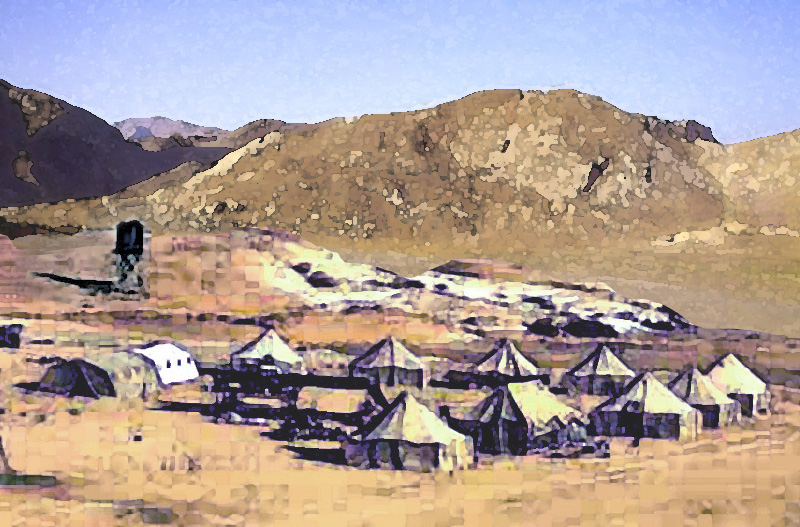
“And so you must imagine the greening of the Wilderness!” Moshe declared to his audience of one. The dim light strings edging the dining tarp barely lit the tables, making the dark only slightly brighter than actual starlight. Equipped with rough but expressive English, Moshe struck Wayfarer as an enthusiastic storyteller, and his usual short temper was nowhere in evidence. The professor supposed it was because he was momentarily playing camp host and not manager. She made a scholarly mental note: the guest-host relationship, well-documented from antiquity, was still thriving in this part of the world. She filed the thought, and caught up with his tale.

“Such heroic years back then, when the Negev was tamed by man’s hand, made fruitful for all the people.” Moshe gestured grandly towards the dark, vacant land wrapped all around the camp. Wayfarer assumed it was a symbolic gesture, meaning other parts of the southern desert: the barren stony flats below the ridge at Beit Bat Ya’anah seemed never to have received the benefits of human efforts, or shown results if they had.

“Kibbutzim like the oasis Yotvata at Ein Radian; Sde Boker, Ben Gurion’s last home,” Moshe continued with his bold pioneer theme. “Revivim raised from the sand – these places and more had sprouted with hope and irrigation and hard work, so that there were vines and olives and lemons, fields and schools and houses, where before there were just barren stones, wild beasts, and serpents.”

And fellaheen villages, and Bedouin tents and herds. Wayfarer’s adamantly impartial brain – the one she applied to her student’s papers, colleagues’ talks at meetings, and her own research – supplied this thought silently. She was interested in facts, complexity, cause and effect, and had no patience for a sanitized one-sided story, whatever the historical setting.  Unaware, Moshe went on.

“But some people saw that though the land was filling with men, their farms, and factories, in another way it was empty. Long before the State, and after rifles became common, hunters shot everything that moved and no one cared. Oryx, ostrich, crocodile, wild ass, cheetah, ibex – they all were gone from the wild places. Many of the places were gone, too: not gone, but improved, no longer wild enough for the animals. So began Hai Bar, the “wildlife” project to put back wild creatures of the Bible into the land, and make national parks and nature preserves for them to live in, like Noah’s Ark on land. At this time the government was paying big money for animals to put back in the desert. It was an expensive project.” He paused, then jabbed one finger decisively into the air.  “And that is where the Greenboim brothers come in.”

“Ah, the Greenboim brothers,” said a voice from the dark. At the edge of the circle of light, Wayfarer could see Wilson Rankle heading toward the mess tent. “Just getting a cola,” he explained.

“The Greenboim brothers?” Wayfarer asked Moshe.

From the tent: “They must have been one slick pair of…”

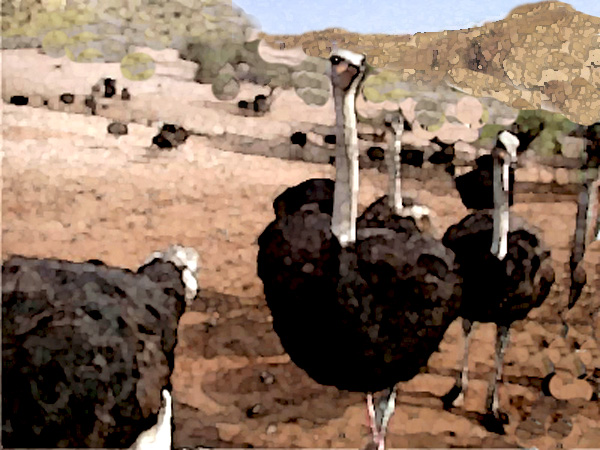
“Businessmen,” Moshe stated, raising his voice over the unsolicited commentary. “The Greenboims: Danny and Avidor, brothers from Jerusalem, looking for a way to help the country and to make money at the same time. All these wild animals had to be bought from other desert countries then brought here at great expense – do you know how much the Shah of Iran wanted for a fallow deer, or the Saudis for an oryx? Danny and Avidor hated the thought of so many Israeli lirot flying out of the country. They asked why couldn’t the money stay here, why couldn’t some of the animals be raised here? Cheetahs, hyenas, leopards, no thank you, Danny didn’t want to get involved with sharp teeth and claws. But an ostrich, that was another story – just a very big chicken, yes? The eggs and young birds could be sold to the government for the nature preserves, yes? And Avidor had experience – he’d worked in a South African ostrich farm as a young man. So, they decided ostriches. The Greenboims would be rich, and the desert full of big birds again: a solid plan. Now all they needed was land, and after a lot of searching, this dry ridge was where they came, holding a lease from the government. They put up fencing to hold in the birds and keep out the leopards and hyenas…”

Wayfarer’s pale blue eyes opened a little, an eaglish, sharpening look that any of her students would have recognized with unease. “Hold on,” she said, “I thought you said there were no wild animals left.”

Well, maybe still a few,” Moshe acceded. “This part of the Negev is far: now, and more far back then, sof ha’olam smola – at the end of the world go left, yes? That was why the land was available.” Having cleared up the point, and received no further interruption, he continued. “There was water at the old spring house back in those days, and they built the lab building to hold incubators for the eggs and a place to make food for the chicks, and the ostriches multiplied…”

“Just a minute,” the professor broke in again, valuing accuracy even above formulaic narration. “You skipped something. Where did their breeding stock come from, if ostriches were extinct in the wild?”

Moshe didn’t have a chance to answer. Wilson Rankle erupted from the mess tent wielding an opened bottle of cold cola, and stepped into the light. Hat-free, the director’s combover was neatly in place. Below it his forehead was pale and his nose was pink. “Where the hell is Dario?” he demanded.  As usual the question went unanswered. Rankle sputtered, “That idiot forgot to padlock the refrigerator!”

“You padlock the refrigerator?” Wayfarer exclaimed. She recalled having that thought about him her first afternoon in camp, without suspecting its literal truth.

“And the pantry,” grumbled the archæologist. “Only at night, for the same reason we padlock the tool shed. Otherwise the Bedouin boys – natural thieves, the little thugs – will sneak over in the dark and help themselves.”

“More likely the Aussies will,” joked Moshe, winking at Wayfarer. “But really, it’s only to make sure the door stays shut to hold in the cold all night when the generator is off. You can’t lock a tent.” He winked again.

The winks surprised her. To Wayfarer’s further surprise Rankle crossed to their table, swigged his cola, and settled as if he meant to socialize. “I can’t believe Chayes entrusted that pain in the ass with a key… he’s flakier than the girl. And I wouldn’t put it past him to help himself to a midnight snack, either.” He seemed to expect support from Moshe on the topic, but only received a shrug.

“That pain in the ass keeps kashrut okay,” Moshe said pragmatically, “which saves time and water. And saves me from more gray hairs.”

And his cooking is a noticeable improvement,” Wayfarer commented. “Go on, Moshe; you were about to explain where the ostriches came from.”

Rankle said, “From what I’ve heard, they stole them.”

“There was no stealing.” Moshe waved a hand. “And who’s telling this story, I ask you?”

Rankle looked at him, then at Wayfarer, then back at Moshe.  “Pardon me for interrupting this… private party.” He stood. “Just make sure the refrigerator is locked up tight before you go to bed, will you?”

Ken betach, sure okay, if I remember so long,” the camp manager replied, knocking his gray head with weather-beaten knuckles as Rankle headed back towards the lab, still clucking about “natural thieves”.  Once he was out of earshot, Moshe said to Wayfarer, “I hate to spoil his big bad mood, so I didn’t say – it’s me who unlocked the refrigerator. I thought a cold drink would be nice for our desert story.”

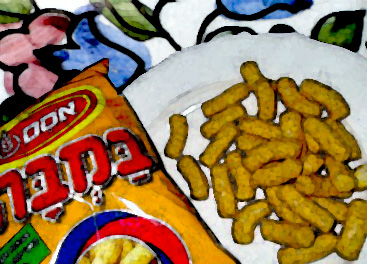
He disappeared into the mess tent, then came out, the host once more, carrying a plastic pitcher of mits and a bowl of something that looked like a beige version of the horrible puffy snacks Wayfarer had banned from the computer room for depositing an orange residue on terminal keyboards. Moshe placed the bowl near her, and held out his palm in invitation. This soon after dinner, the professor was neither hungry nor thirsty, but she dutifully accepted her role as guest. She took the plastic cup of reconstituted fruit juice Moshe offered – there were ice cubes in it, the first she’d seen since arriving – and tried one of the starchy puffs.

“Is this… peanut butter?”

Ken, yes; Bamba snacks – zeh tov, zeh tov, it’s good for you, all natural. More, please.” He pushed the bowl closer. “They put vitamins in.”

“What an extraordinary flavor.” Wayfarer intended this response to be imprecise enough to pass for approval.

But Moshe didn’t seem to notice her lack of enthusiasm: he was shaking his head again, staring after Rankle. “All season he’s like this with me… How do you steal ostriches?” he demanded. “Feh!” He swiped his palm through the air dismissively. “There was no stealing,” he said.  “They did not steal ostriches,” Moshe raised his shoulders. “Well, at least not exactly…”

To be continued.

Posted by Allison on Mar 20th 2012 | Filed in Beit Bat Ya'anah, archaeology, art/clay, artefaux, pseudopod waltz | Comments (0)

What happened at Beit Bat Ya’anah: part 14

UPDATE: I’ve just made it easier to navigate between episodes of What Happened at Beit Bat Ya’anah. Now at the beginning of each new episode there are links to previous installments: one to the immediately previous episode, and one to the very first episode.  In addition, there’s a link at the end of each episode to click on so that you can read the very next one in the series, if it’s been posted.  You can always click on the Beit Bat Y a’anah category in the left-hand sidebar, but it’s a little awkward to navigate forwards through time from the bottom up now that the series is stretching into more episodes. (My apologies to those readers whose RSS feeds may have been bombed with updates this morning as a result of the changes, although I hope it’s not many of you!)

This is the fourteenth installment of the series. The following links will take you to the last episode before this one, and the very first episode:

Read Part 13 ………………………………………………………………….For new readers: Read Part 1

Previously:

Having taken a brief side-trip to observe the volatile and imperious Avsa Szeringka at home in her Institute near London, we rejoin the excavation at Beit Bat Ya’anah (BBY), where Professor Wayfarer, still frustrated in her efforts to observe Szeringka’s graduate student, is once again considering whether or not to extend her stay at the remote, unpromising site in the Negev desert. To her own surprise, every fact she learns about BBY – such as its lack of ancient burials and its brief stint as an ostrich ranch – makes her more curious about the process of excavation, the many unanswered questions about the place, and its residents, both past and present.


Meanwhile back at the ranch: earthmoving

Einer Wayfarer had never been among people who knew or cared so much about dirt.

As a well-established and respected figure in her recondite field, the professor had at her disposal considerable quantities of highly specialized and well-integrated philological, linguistic, and literary knowledge. But after eight days assisting the excavation team at Beit Bat Ya’anah, the professor had acquired a range of experience which she’d never expected to accrue in her lifetime – most of it concerning dirt, the objects people lost or left in it, and the best tools for moving large amounts of it quickly but carefully.

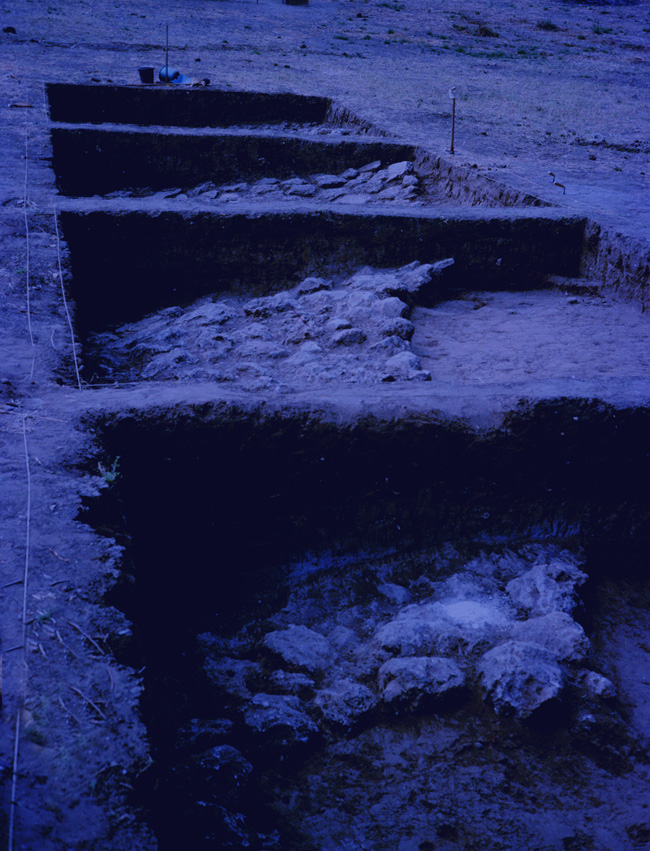
During the past week Wayfarer had helped shift a lot of dirt. Though exempted by seniority from some of the more strenuous tasks, she’d watched the younger folk swing a pick to loosen the hard soil, then use the sturdy hoe called a turiyah to fill a guffah or a dli to pass to someone topside to push to the soil dump in a wheelbarrow.

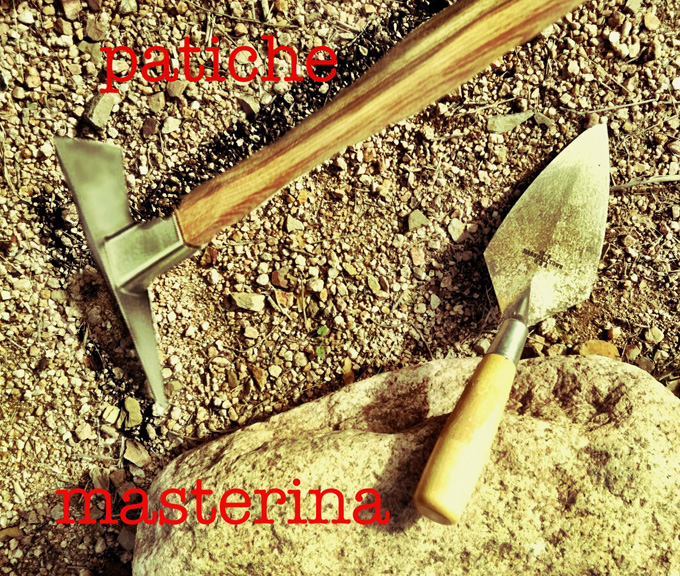
Wayfarer herself had shake-sieved cubic feet of stony soil for infinitesimal clues to lives from distant times. She learned to use a masterina to work around an object in situ, to level surfaces, and to remove small amounts of dirt. She observed that Marshalltown was the trowel of choice among the Americans, whereas the Israelis and Aussies preferred no-name brands from local building suppliers, with the result that unfortunate young Eric took constant flak from both sides about the British-made WHS 4” pointing trowel his parents had mail-ordered specially from a posh archæological outfitter in London.

Thanks to Rory’s instruction, Wayfarer was becoming handy with a patiche and could use one to polish a balk without undercutting, to reveal a vertical stratigraphic witness to the sharp interpretive eyes of the senior staff. Zvia showed the professor the difference between a packed-dirt floor horizon and an organic-rich kitchen midden or an ashy interior hearth feature, and how it was possible to articulate a wall with acceptable statistical probability from a poor showing of three or four rough-hewn blocks or even sketchier field-cobbles. Wayfarer learned that a pisé wall was different than a mud brick wall, and that both decayed by dissolving from the bottom up between the corners, as opposed to stone walls which dilapidated from the top down. She learned that stone tools weren’t necessarily a sign of great antiquity: handy rocks were used in every era for many reasons, and ancient tools were often kept and used through centuries, their presence in a stratum providing no more than a terminus post quem. Lior had helped her construct a rudimentary but functional pottery typography in her head, and she could sort with some accuracy the local chalcolithic ceramics from Bronze Age. She was surprised to learn that there were shells from both the Mediterranean and the Red Sea found at the land-locked site, and that it was necessary not only to identify and quantify them, but also to field-screen them for signs of secondary usage by looking for signs of edge wear or drill holes. At the end of the day when the sun angled low, the professor had climbed back onto the hill to help anchor the ladder for Mikke who, with her billowing gypsy skirt tucked into her waistband shirwal-style, cantilevered riskily from upper rungs in order to shoot down onto squares with newly uncovered features or strata; and Wayfarer had held the stadium rod for Shams’s precise transit surveys of the growing length of meager, mainly Middle Bronze Age walls visible on the ridge.

The professor had quickly realized that what had at first appeared to her to be a grubby collection of callow, work-worn drones was actually a field-hardened team with specialized skills carrying out a project where success was neither guaranteed nor likely to be spectacular, and failure was irreversible: archaeology was controlled destruction – once a feature, locus, or a soil horizon was removed, it was gone beyond recovery. In an excavation so devoid of significant cultural artifacts, the soil and rocks they were uncovering were everything: even a lowly trowel-wielding novice such as herself had to pay close attention in order to avoid committing irreparable errors of excavation like digging through a foundation trench or clearing rubble that turned out to be a casually paved floor.

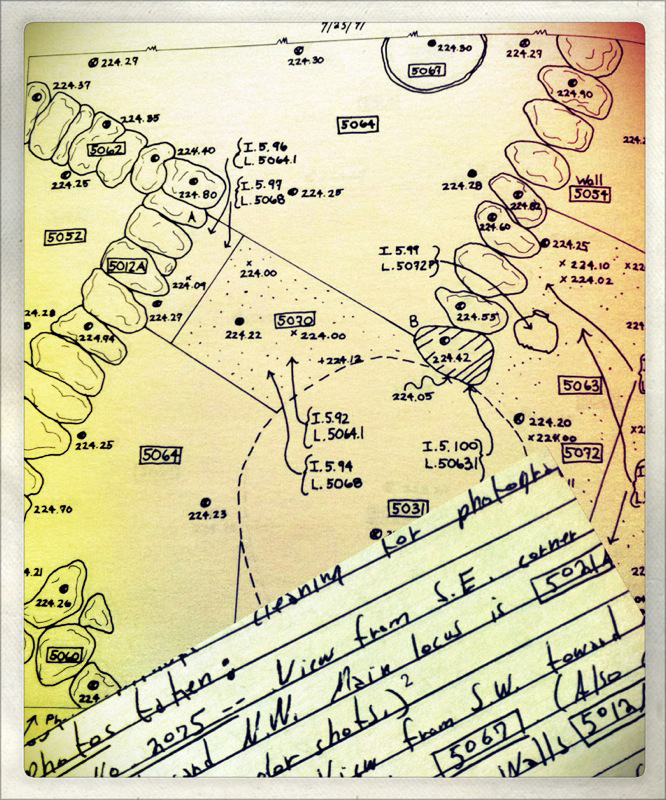
The only thing that mitigated this destruction was meticulous record-keeping – written, quantified, measured, sketched, and photographic – since it preserved information for interpretation and, inevitably, later re-interpretation. The schedule was unvarying: digging on the Hill in the morning and recording in the lab in the evening, but the interpretation was constant. The staff spent endless hours on site, in the lab, and around the dinner table in earnest and democratic discussion of minute changes in soil, the relative stratigraphy between areas, and the chronological relationships of excavated features, levels, and loci.

Watching the senior staff at work, Wayfarer began to comprehend the blend of informed observation, technical expertise, bare-knuckled logistics and personnel management skills that a successful dig demanded. She saw that BBY’s directors Chayes and Rankle – whatever she might think of their contrasting personal styles – were each experts in their own ways, both indispensable to a smooth field campaign. Keeping a sharp eye was a question not only of archæological necessity, but sometimes of fundamental safety, as Wilson Rankle reminded them all in a harsh public scolding of young Eric. The director had discovered an undercut 2 meter balk in Area C which he proclaimed to be “an unmitigated catastrophe waiting to happen, Eric, with your damn name writ large upon it.”

In addition to the arcane secrets of managing dirt, the practical skills of desert life were now Wayfarer’s too. She’d learned the importance of drinking water before she was thirsty and of never picking up sun-heated tools by the metal parts. During breaks she learned to value even the smallest scrap of shade, and was known to take refuge in big Rory Zohn’s substantial umbra despite the olfactory risk. In camp, she knew to check her shoes each morning for scorpions and centipedes, to always carry a flashlight after dark, and to keep her distance from the flat rock at the downhill end of the communal sinks because of the yellow-jackets during the day, and at night, too, since a small viper had taken up residence underneath to ambush tiny scurrying mammals attracted by the sink’s moist outflow. Less usefully (although more likely to impress her students back in Lassiter), because of the international nature of the crew and the earthy quality of conversation in the lab in the evenings, the professor now knew how to exhort someone to go screw themselves in four new languages including – thanks to Shams – both Urdu and Strine.

But she hadn’t planned on staying more than a few extra days, and that time was up. Originally, Wayfarer had postponed her departure on Avsa’s behalf, but now, a little more than a week later, there were other reasons the professor was considering extending her stay at “Two-Bit Yod” (as Rory had semi-affectionately subverted the Hebrew letters Beit-Beit-Yod of the site-abbreviation, written on every find tag and locus card). One main reason was purely altruistic: this close to the end of the season, any assistance, even rookie, was helpful. The site was chronically short staffed due to the Lebanese conflict: the Israelis kept having to report for brief stints of discreet military service. Yael the ethnobotanist was the latest to disappear – early one morning Wayfarer saw him sling his kitbeg into the back of the site Landrover where it settled with the somber clank of gunmetal. Chayes drove him out to the highway to hitch a ride to Be’er Sheva – but later at tea, no one said anything about this departure. Wayfarer thought it likely that Aman, Israeli military intelligence, recruited as heavily among archeologists as other governments had during conflicts in Europe and the Middle East – in retrospect, she suspected that Chayes’s earlier absence had had more to do with Aman than with his son’s spider bite.

So, despite the heat, discomfort, and insect life, Wayfarer’s mind was made up. She asked Amit if an extra pair of hands would be welcome; he smiled and clapped her shoulder, saying he’d let Moshe know. Rankle she merely informed that she was staying, and received a pessimistic response doubting whether the water would last. It only remained for her to ask the Aussies, who were headed out to Eilat for weekend leave, to pick up some things for her: a bottle of Hawaii shampoo, a sack of clothes pins (her colorful plastic ones in a clever mesh bag had gone missing off of the line), a bottle of red, and she’d be good for another week, until the end of the season.

Practicalities being satisfactorily settled, the professor spared some attention to the lingering question of Avsa’s uncooperative protégé, who continued to avoid her like a student with a delinquent thesis chapter. But she didn’t give him much thought. When it came to coaxing results out of students she knew more than one way to skin a cat.

No; Wayfarer was definitely not yet ready to leave. By Saturday night, or Sunday morning at the latest, she should have a bottle of wine to look forward to. And ever since Amit had mentioned them, she’d been dreaming about herds of strong-toed ostriches wandering freely among the jumbled rocks of the Upper Wadi, their big liquid eyes peering deep into her resting mind.

To be continued… To read the next episode, “Hai bar and hospitality” click here.

Posted by Allison on Jan 31st 2012 | Filed in Beit Bat Ya'anah, archaeology, art/clay, artefaux | Comments (0)

What happened at Beit Bat Ya’anah: part 13

Note to readers: It’s been a while since I’ve had the time to advance the tale of the archæological site called Beit Bat Ya’anah and its inhabitants. The progress of Professor Einer Wayfarer’s efforts on that remote ridge in the Negev Desert to observe the seemingly out-of-place and elusive protégé of her controversial colleague Avsa Szeringka was temporarily interrupted by non-literary Three Star Owl activities: a busy fall season of pottery-making for shows, sales, and holiday shoppers kept me more in the studio than at the keyboard. Posting on my blog has suffered in general: there simply hasn’t been enough time to assemble both words and art for weeks and weeks. But things have relaxed somewhat now, and I’d like to get back to telling the tale. So far, all the action has occurred at the dig site, and only a few days have elapsed since Professor Wayfarer’s unenthusiastic arrival there.

This is the thirteenth episode in the series.  To read the twelfth episode, click here. If you wish to catch up on the entire story in full detail, click here to start at the very beginning.  At the end of each installment, there’s a link to click to continue on to the next one. If you need a less thorough reminder, or a basic intro to the fiction I post here, there’s also a brief summary of both What Happened at Beit Bat Ya’anah and its prequel The Ganskopf Incident in this post.

Now let’s take up the tale again, first by jogging the memory (caution mild spoiler alert for those who haven’t read the rest of the story yet), and then by a brief change of scene, with a look at Professor Wayfarer’s volatile European colleague Avsa Szeringka, who is the director of “the Institute” and who may be behind much of what has happened in the story so far.

Previously, we learned that Wayfarer was enticed to the remote archæological site “at the behest of her colleague and friend Avsa Szeringka (pronounced “zhə-RING-ka” with a zh like in Zsa-Zsa or French je), who had somehow herself managed to remain comfortably ensconced at the Institute near cool, gray Oxford,” by means of an imperious letter in expressive but convolute and ambiguous English, which is “not Avsa Szeringka’s second language, nor even her third.” This letter obliquely requires Wayfarer to seek out “an artefact” at the site, which she eventually realizes is actually a person: Dario, Avsa’s sleek grad student of uncertain linguistic and ethnic origins. While Wayfarer is making slow progress trying to understand who Dario is, his mentor is monitoring – if not manipulating – events from afar.

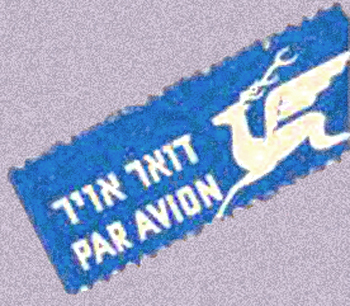
[Note: for anyone wondering about the prominence of hand-written correspondence in this story, now is a good time to remind you that the action takes place in the early 1980s, when email and cellular phones were just beginning to be used in universities and businesses. For participants in a remote desert dig, telephone access would be limited to weekend leave and payphones in town. For overseas communication, everyone would have relied on gummed stamps you had to lick, crinkly onion-skin air-mail paper, and postal delivery times measured in days, if not weeks, with letters being driven into town and mail fetched back to the site no more than once or twice a week, along with groceries and other supplies.]

Correspondence: considering two letters

Her silk-robed figure barely discernible from the rare antiques which furnished the damask-curtained, high-ceilinged room that functioned as both boudoir and office in her eponymous Institute near Oxford, Avsa Szeringka didn’t look up as her assistant placed the daily mail on the desk in front of her. It was the usual thick stack, arranged as Avsa required with the journals and manuscripts to be reviewed at the bottom, the routine business correspondence next, and any hand-addressed personal missives sorted to the top to be read immediately if they were from someone of whom she approved, or to be individually snubbed, if not. Bills she never saw; she had people for that.

This morning two envelopes interested her. She took them from the top of the stack and pushed the rest across the desk, disturbing the striped cat bunched at the corner of the Turkish leather writing pad. The tiger opened its mouth to complain, but nothing came out but a staccato fishy click, which Szeringka ignored, except to briefly bare her teeth back at the animal as she placed the two interesting letters in front of herself.

She considered them. They were both postmarked on the same date in Be’er Sheva, Israel, and they were each addressed with familiar but contrasting scripts. Unexpectedly, both packets were flimsy; neither could have more than one sheet of paper sealed inside. This was disappointing: she’d hoped to provoke heftier responses from each of her correspondents.

She reached a long-fingered hand towards one, but picked up the other instead, opened it and read it quickly.

Avsa,” it began bluntly, “your ‘artifact’ is decorative but uncooperative and gives the distinct impression of preferring not to be handled, at least by me. This is an attempt to extend your metaphor accurately, and not prurience. Otherwise, the Negev is hot as hell, the living conditions are primitive, and the insect life is both appallingly forward and unanimously venomous: wish you were here.” Signed briefly, “E.W.

Szeringka sniffed. The gruff humor of the message was hardly worth the postage to transmit it. If Einer didn’t have more to say, then it was clear that her dear friend and colleague wasn’t paying sufficient attention. Avsa made an impatient sound with her tongue. This letter required no answer.

She let it drop and picked up the other. Its external address was tidy and elegant, much more precisely written than Einer’s hasty American scrawl. She passed the unopened envelope briefly under her nose, noting a coniferous odor, faint but still detectable: she’d given him the fountain pen with the amber-scented ink herself, ostensibly a prize for some end of term academic achievement. Unperfumed versions of these showy trophy pens were coveted by their awardees, treasured carefully and displayed prominently on desks all over the Institute, and not, she knew, generally employed to write with. How like him to think so little of the prize, or of the inconvenience, as to bring an old-fashioned reservoir pen with him into the field, and actually operate it in the desert heat and grit. Avsa slid a fingertip under the envelope flap and, unfolding the page, read what he’d inked there.

When she had read his words twice – there were only a few – she stood and moved to the window, parting the heavy draperies a hand’s width. A blade of northern sunlight slid in, not gray at all but a sharp white ray of August, showing the many lines on the pale planes of Szeringka’s face in deep relief.

The lines at the corners of her mouth deepened. Yes, each of these letters was disappointing; the first, perhaps predictably, but the second, shockingly. Uncooperative, Einer had written about her student. Avsa had thought this must be irritable exaggeration, until she had read his letter.

She turned her head from the window and called out to her assistant in heavily accented English. “Wynn, tea! The osmanthus oolong whole leaf, I think, this morning. And a sheet of the official letterhead.”

Einer had said he preferred not to be handled. Yet that was precisely what his letter — that impertinent, rebellious tone in so few words! – required her to do. He had left her no choice but to handle this, and not gently.

Avsa Szeringka abruptly pushed back the floral drape wide, flooding the walls, the carpet, her dressing gown, her slippers, herself, with light. Really, it shouldn’t be necessary to strong-arm the stubborn creature: like it or not, he was going to have to take some responsibility in the effort. She strode back to her desk, pushed the cat off with animus, and while impatiently waiting for Wynn to arrive with both tea and stationary, began to calculate postal turn-around time to that stony armpit of the desiccated south while drafting stern and irrefutable points across the offending letter’s envelope. This time, wishing to be perfectly understood, she didn’t waste time with English.

To be continued…. Click here to read Part 14 “Earthmoving”

Posted by Allison on Dec 20th 2011 | Filed in Beit Bat Ya'anah, archaeology, art/clay, artefaux | Comments (6)

Come visit the Ossuary

Next Friday Saturday and Sunday Oct 21, 22, 23,  is the Camelback Studio Tour, and Three Star Owl will have wares available for you to peruse and perhaps purchase. Other artists’ studios nearby in the neighborhood will be open as well, with more than 20 artists offering their art for pre-holiday shopping. Support local artists and artisans and stop by: 10-5, free to enter all the studios.  Click here for details.

<< sneak peak of a piece that’s about to fly across the country

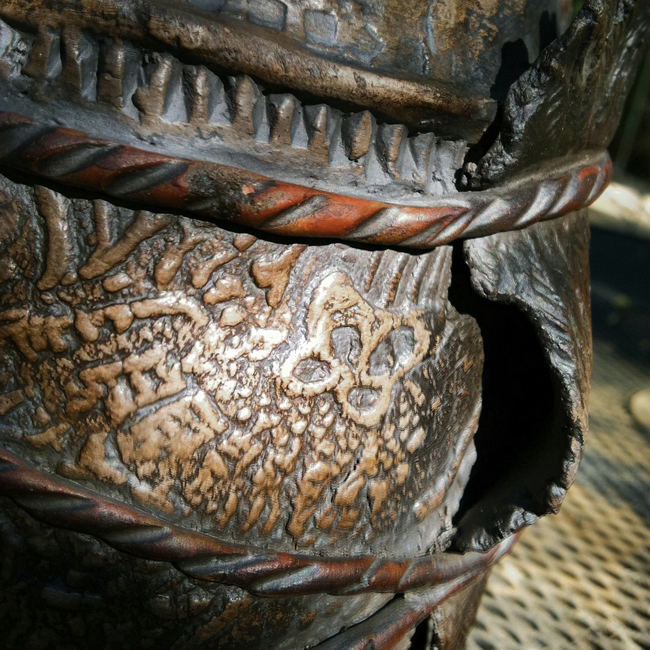
During the event, a new piece called “Ossuary, An Archæology of Resurrection (<< detail left) will be lurking in the corner, awaiting shipping to St.Louis for an upcoming show, “Death and Rebirth” at Maryville University, curated by James Ibur.  St. Louis artists Ruth Reese, Ron Fondaw, Eric Hoefer, Lili Bruer, Renee Deall, Tim Eberhardt, Mary Ann Swaine, Matt Wilt, Susan Bostwick, Jimmy Liu as well as national artists Amanda Jaffe, Chris Berti, Russell Wrankle, Kurt Weiser, Adrian Arleo, Arthur Gonzalez, Ben Ahlvers, Mark Messenger, Pete Halladay, Paula Smith, and Allison Shock will have work displayed from Nov 2, 2011  through  Friday, Dec 2, 2011.

Posted by Allison on Oct 18th 2011 | Filed in Events, archaeology, art/clay, artefaux, close in, effigy vessels, three star owl | Comments (0)

What happened at Beit Bat Ya’anah: part 12

This is the twelfth installment of a series. There’s a link at the bottom of the page to the thirteenth installment.  Read Part 11 by clicking here, or start at the very beginning by clicking here.

Previously:

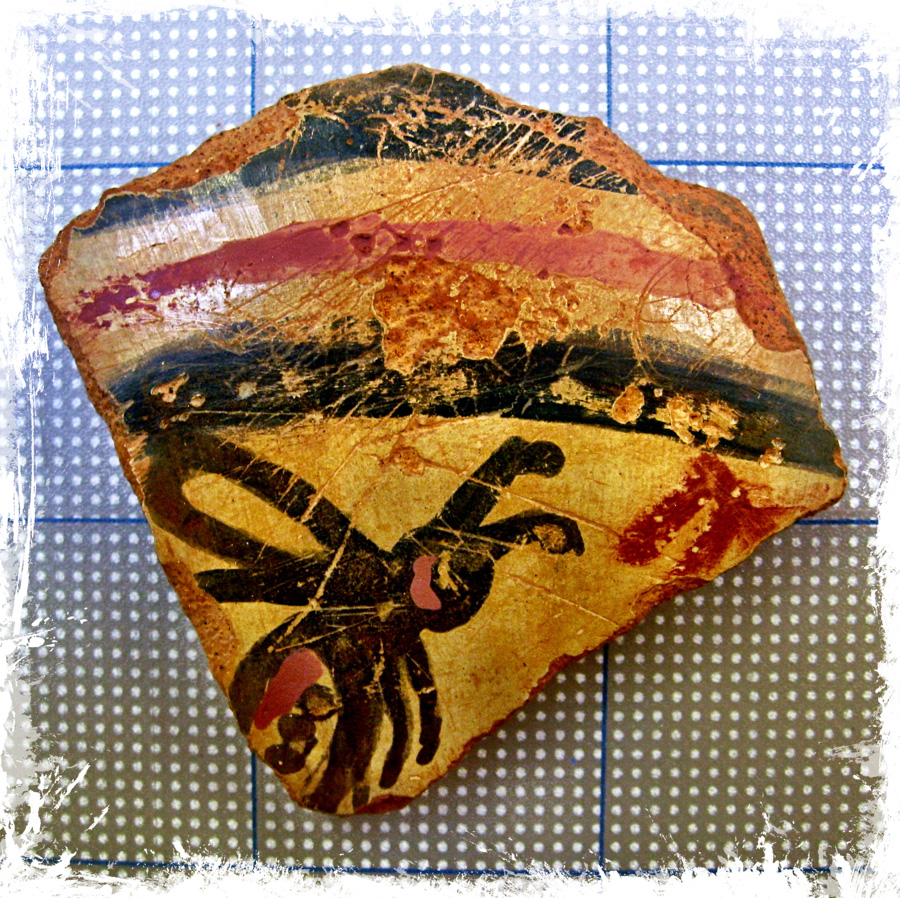
After encountering an anomalous fragment of pottery decorated with a bee and a possible flower, the Beit Bat Ya’anah staff were hotly debating its origins. Leaving them to it and wandering out across the moonlit compound, Professor Wayfarer had recalled a fragment of poetry with a similar motif, causing her to wonder who the people were who had made this rocky site their home.

The Nature of the Hill: secrets and surprises

Outside the lab building, Einer Wayfarer glanced at her watch.  It was not quite 8.30, and she was ready for bed, unaccustomed to the long active hours on the hill, which were so different from her sedentary days behind a desk in her office, at the library, or in the classroom. She was surprised to find that she could read the hands of her wristwatch in the moonlight – the waxing moon was only slightly more than half full, yet she noticed her squat shadow running ahead of her sharp along the stony ground. In Lassiter the lardy moon was never this bright, even full. Here, colors were discernible in the clear desert moonlight. You could read poetry by it, Wayfarer thought – hell, you could write poetry by it, if you were that sort of person. If you were that sort of person.

As though intent on enabling such romantic pursuits, the moon lit two spots of bright color as the professor passed downhill of the shadowed dining tent: aniline pink hair and a man’s white shirt – two figures, leaning together against the end of one of the tables. Mikka the ex-cook/photographer and the elusive Dario had found a way to pass the evening that didn’t involve tiresome record-keeping in the ill-lit lab.

Unsurprised, Wayfarer looked and then looked away. To judge by the intimacy of their embrace, she concluded that the rearrangement of kitchen duties hadn’t impaired their acquaintance. It occurred to her to sympathize briefly with Avsa Szeringka for having to supervise the young man as a graduate student.  He seemed to be expert at simultaneously eluding unwanted contact and attracting attention to himself, a curiously infuriating skill set for an academic advisor to wrangle, and likely to create disruptions in a research setting.

Less earthily and more celestially, it also seemed to Wayfarer that the gibbous moon was in a forthcoming mood, naughtily giving up other people’s secrets to anyone who was paying attention. It would be foolish to not take advantage of its revelations, so she changed her mind about heading to bed. Instead, she climbed upward to the crest of the ridge where she had first stood with Wilson Rankle, just yesterday. She arrived at the top, puffing slightly and disappointed in her hope for a slight breeze.

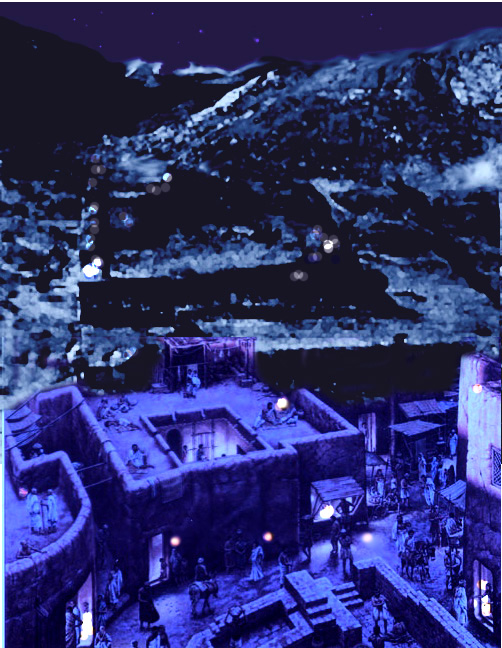
Catching her breath, she looked down on the site. Einer Wayfarer was not superstitious, or prone to fancy. But she was also not unimaginative: over the years, she had acceptably and productively harnessed an active imagination to the yoke of scholarly creative thought. So although she didn’t expect to see a ghostly diorama of moonlit re-creation laid out before her — an ancient town’s crenellated stone-and-mud walls dimly peopled by long-dead shades of priests and goat-herds and potters and children and soldiers and dogs, shouting and tending smoky cooking fires, chasing screeching chickens, drinking wine, dying clothes, writing letters, and tanning hides — she was open to the possibility that the site, seen quite literally in a new light (to use that well-worn cliché she deplored in less careful academic writers) might show her something she hadn’t observed before, something more human than the dry chronological classifications recited by Wilson Rankle in the glare of daylight.

And she was not too stuffy to wish for a time machine to confirm such imaginings, since the methods of archeologists seemed to her, paradoxically, to be both technically sterile and too subjective all at once. Whereas one could easily imagine these walls long ago corralling all the same activities that people engage in today – cooking, lying, loving, keeping secrets, making mistakes, laughing, prevailing, struggling – it was the surprises, the things you’d never guess, that interested Einer Wayfarer. It was in surprises where progress lay in understanding ancient lives, in fleshing out people who lived long ago.  Surprises like a jar handle bearing a hidden ambiguous symbol, a painted bee drawn to an exotic flower on a sherd, and a young man whose tapped initial Rs and slightly retroflected Ss were not fully explained by either southern European origin or Scottish influence.

As she moved along the ridge to a better vantage point, she realized she wasn’t alone. Just ahead of her, perched on a flat rock, sat Amit Chayes.

“Does no one around here sleep?” she asked.

“Sleep? It’s still early,” Chayes said, turning. “Erev tov, Einer. Please sit,” he invited her. “Doing what?”

“Seeing what the moon has to show. And you?”

“The same. And the tables were occupied.”

Wayfarer chuckled. “Danish lessons, do you suppose?”

“I can remember being so young, can’t you?” Chayes smiled. “I met my wife on a dig. These things are to be expected — it’s natural.”

“Indeed it is,” Wayfarer said, not answering his actual question, and doubting the pertinence of matrimony in this instance. “In fact, Rory Zohn was just touting the advantage of working within natural systems, although his example was aptitude for cooking, not sex.”

“If camp gossip is true, perhaps in this case it’s related,” Chayes laughed. “Well, I should spend more time in the lab. I didn’t know discussion there was so intellectual, usually.”

“It seems like you’ve put together a fairly good crew.”

“Young, but good,” he agreed. “Pretty good. Some hard workers, some needing a bit more guidance, more experience. As usual. We were lucky: except for Zvia Ben-Tor, who requested to come, our permit came so late the crew was filled in the last minute with overflow from other site applicants.”

“Why is that?”

“The government is preoccupied with the Lebanese events. And so many archeologists are called up for military service at times like this, the Reshut HaAtikot — the IAA — is slowed down to an even less efficient pace than usual. Our small site had low priority.”

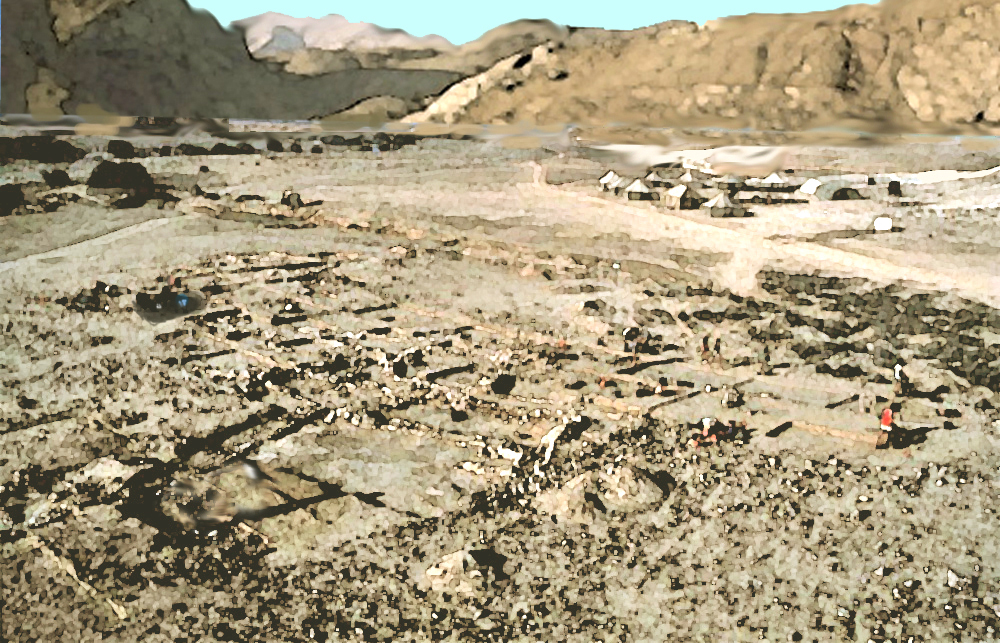
“Why are you digging here, Amit?” Wayfarer asked. She looked out over the hill, onto the squares making an orderly framework deeply cut against the pale, stony hilltop. Within the inky pits were dim outlines of walls and floors, none complete, few rectilinear, not at all aligned with the carefully surveyed lines of the archæologists’ grid, running their own imprecise, human-laid courses under the sternly oriented, scientifically imposed balks.

“Ah, the staff have been complaining to you,” Chayes stated, answering her meaning and not her words. “The simplest answer is archeological: because there are so few remains later than the Bronze Age at the site the Chalcolithic and even earlier levels, if present, should be relatively well-preserved. But also…” He glanced over his shoulder at the sheer cliffs that rose above the site a few hundred meters from where they sat. “I think that the place has… Well, to say it has secrets is too dramatic; all archeological sites have secrets; it’s their nature. So, I will say instead surprises. For instance, I was hoping you’d confirm that character on the amphora handle as wehériəl.

His words resonated uncannily with her earlier thoughts. “You’re looking for evidence of Elennui culture?” Wayfarer asked. “That is a surprise.”

Chayes shook his head, “No; no, I’m not looking. That’s unsound technique in our field: you almost always find what you look for. But, if it were to show up, that would be a surprise.”  He shrugged. “So, I hoped the symbol was evidence that Elennui speakers have lived here.”

Wayfarer cleared her throat. “I wish I could have confirmed it, but…”

The archeologist waved a hand. “No; of course. It was sound scholarship, much more important. And no matter – there is still much dirt to move.”

“Who has lived here?” she asked. Responding to Szeringka’s peremptory summons, Wayfarer hadn’t had time to read site reports, and Rankle’s dull orientation had meant little to her.

Chayes paused before responding. “Do you mean people of the Bible?”

She supposed he was accustomed to that question, perhaps irked by it. She replied, “No, that’s not my bias. I simply mean people.  Any people, of any book.  Or of no book. Who has lived here?”

“This is Israel – who hasn’t lived here?  Over the millenia, this ridge has been occupied by foreign soldiers; nomads from far and near; tale-telling hunter-gatherers with stone tools; well-organized patriarchs with scribes and cisterns, pottery and laws; zionist idealists; entrepreneurial ostrich farmers. Optimistic archeologists. People who left things, and people who are looking for those things. People hoping for secrets – surprises. But the site has kept its secrets well, I would say.”

“So, it’s not a tell…” Wayfarer punned, not sure Chayes’s English was colloquial enough to catch it.

He shrugged and made a literal reply. “Our hill is not a tel, technically.  Just superimposed occupation levels along a ridge – most of the topography is geologic, natural – piled up outwash from the upper wadi, now eroding slowly. But I understand your joke – and no; it is not a tell, in any sense. Especially in one way,” Chayes added, “the site has been entirely mute. The staff is right – Beit Bat Ya’anah is missing something.”

Wayfarer waited.

“We’ve sounded, and surface-surveyed across the whole ridge, and even searched downstream in the wadi. It’s a small but enduring habitation: one would expect…” the archeologist broke off, then finished bluntly, “No bones, no teeth. No evidence of burials or any human remains.”  He shrugged once again.  “Well, as I say, there is much dirt yet to move.”  Chayes turned back to the moonlit walls below, perhaps again hoping to be shown secrets, or at least surprises.

Einer Wayfarer took the hint, and stood to go. But she couldn’t keep from asking one more question. “Ostrich farmers?”

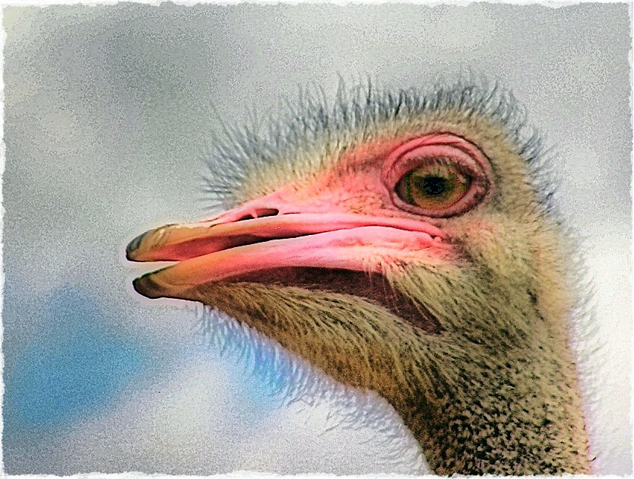
“You don’t know the meaning of Beit Bat Ya’anah?” Chayes asked.  “ya’anah is the female form of ya’en, ostrich. The name means ‘House of the Ostrich’s Daughter’. Ask Moshe sometime – he loves to tell that story.”

To be continued…

To read the next installment, Part 13 “Correspondence” click here

Posted by Allison on Aug 27th 2011 | Filed in Beit Bat Ya'anah, archaeology, art/clay, artefaux | Comments (4)

Next »