Archive for the 'close in' Category

You are currently browsing the archives of Three Star Owl – Functional and Sculptural Clay Artwork with a Natural History .

Not my hen

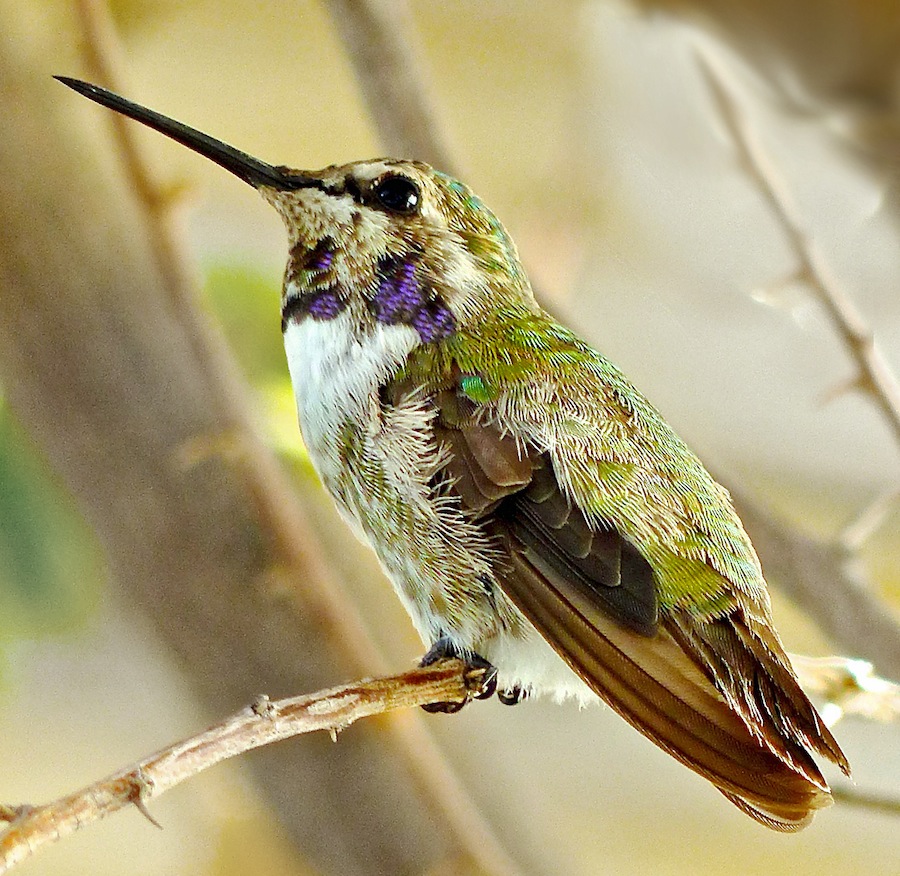
Anna’s hummers are capable of setting clutches just about year round in warm climate states like Arizona and California.  The little males have been doing their combo territorial and courtship dives — which culminate in a loud, popping “CHEEP” sound since December, at least in our neighborhood.  This little Hen in Tucson has gotten a bit of an early start to her reproductive year: here’s a digiscoped shot (acceptable if not perfectly sharp) of her on her fresh nest >>

I was visiting Kate’s house in Tucson on my way back from Wings Over Willcox, when the motion of the tiny busy hen happened to catch my eye as she flew up into her nest with a beakful of some sort of light-colored fibers to add to the construction.  Mature Aleppo pines seem to be a favored nidification tree for Anna’s, where nests are often built on top of the smallish pinecones, as in this case.  I wish her luck, and I hope there’s not too much more winter weather for her to sit tight through!

(Photo A.Shock)

Posted by Allison on Jan 18th 2012 | Filed in birds, close in, hummingbirds, increments, natural history, nidification | Comments (0)

Tale of Two Tiny Tarantulas

On our way home from our weekend getaway, E and I stopped at Montezuma Well National Monument.  It’s one of our favorite places: a compact confluence of archæology, geology, and natural history. If you haven’t been there while visiting central Arizona, I highly recommend it.

>> Montezuma Well and beautiful fall color (all photos in this post either A or E Shock; click to enlarge)

As we were walking back to the truck, admiring the glow of the cottonwoods in the creek bed and dramatic clouds in a sapphire blue sky, I remembered to look down.  It was a good thing I did: underfoot were a couple of spiders.  Unaware of each other or of us, they were not going in straight lines as if to get from point to point, but were moving around deliberately, as if looking for eight lost contact lenses.  Each was a moderately large animal, the size of an adult wolf spider.  But they had round cephalothoraxes, and were black with lots of gray spiky hairs on their abdomens and stocky legs.  I bent over for a closer look, and wondered if I were seeing tiny tiny tarantulas.  Tiny for a tarantula, that is — they were still fairly large spiders, about an inch and a half from toe to toe.

<< on the go, places to be, females to find

We watched them for a while, got some pictures, and went on our way, hoping the squabbling tourist family on the trail behind us wouldn’t accidentally flatten the little guys through inattention.

Back on the highway in cell phone range, and uncertain if we’d really seen tarantulas, I consulted the internet and discovered this site: So You Found a Tarantula?  (In case you ever need to know how to transmit a live tarantula through the US Postal Service — and apparently there are good reasons to do this — this is your site.) It solicited questions, specimens for ID, and generated answers about things tarantular, including citizen science and advice about tarantula husbandry.

>> “Do not get too close: I am assuming the posture that indicates I am willing to kick irritating urticating hairs off my abdomen at you.”

Through this post on the website of the American Tarantula society, Dr. Brent Hendrixson of Millsaps College is trying to increase what’s known about American tarantulas, which for all our familiarity with them from heebie-jeebie movies turn out to be poorly understood in terms of their systematics and life history.

<< Keen sandal for scale.  Tiny tarantula is just to the left of the yellow leaf.

The website was fascinating, but it assumed you already knew you’d found a tarantula — it wasn’t set up to answer the question “Did I find a tarantula?”  And we weren’t sure: aren’t all tarantulas huge hairy hand-sized horrors?  Other tarantulas I’ve seen in the wild or in captivity were all enormous.  If tarantulas we had seen, then they were “toy” tarantulas, the chihuahuas, the tea-cup tarantulæ of the arachnid world.

After a little more research on the Web I was still undecided about their tarantularity, and decided to email Dr. Hendrixson photos of one of our dinky dudes asking if we had seen tarantulas, and if so, what kind?  Within minutes, I’d received an email reply from him: “Definitely a tarantula.”  This was exciting!  Better yet was the next part: “There are a number of ’small’ species in Arizona and it turns out that this one is most likely undescribed (i.e., doesn’t have a name yet).”

>> Possibly, these were adult males  wandering about searching for females’ burrows, where the ladies were waiting for male callers.

Sure enough, according to this website, there are 14 species of tarantula, all in the genus Aphonopelma, that live in Arizona: three in Maricopa, three in Pima, three in Coconino, etc.  But in Yavapai County, situated between Coconino County and Maricopa County, no tarantulas have been scientifically described.

This doesn’t mean that we discovered an unknown, new species of tarantula (although it is a possibility).  It’s just that biologists haven’t poked around enough tarantula burrows to know who answers the door in this location — it could be an already described species that also lives in an adjacent county.  We’ll have to wait to see what science decides.

In the meantime, we can fantasize about eponymous lightning striking twice: first Thermogladius shockii, now Aphonopelma shockii?  Well, of course not (that’s not how scientific nomenclature-giving works), but you can’t blame us for pretending.  Nevertheless, I’m still excited about having spotted diminutive, un-named tarantulas in the wild, who are living their lives entirely unconcerned that no one has ever slapped a latinate moniker on their hirsute posteriors.

Bonus etymology

All American tarantulas belong to the genus Aphonopelma.  According to Henry F. Beechhold, this name is derived from the Greek elements aphonos, “silent”, and pelma, “[sole of the] foot”.  (I haven’t cracked Liddell and Scott on this one, so we’ll have to take his word for this.)  I think it’s unfair of tarantulas — even tiny ones — to be pussy-footed; I’d rather be able to hear them coming. On the other hand, I once heard the click of a cockroach’s feet as it walked across ceramic tile, and that was fairly disturbing, so maybe, on second thought, silence is golden.

Posted by Allison on Nov 22nd 2011 | Filed in Invertebrata, close in, cool bug!, etymology/words, field trips, natural history | Comments (0)

Come visit the Ossuary

Next Friday Saturday and Sunday Oct 21, 22, 23,  is the Camelback Studio Tour, and Three Star Owl will have wares available for you to peruse and perhaps purchase. Other artists’ studios nearby in the neighborhood will be open as well, with more than 20 artists offering their art for pre-holiday shopping. Support local artists and artisans and stop by: 10-5, free to enter all the studios.  Click here for details.

<< sneak peak of a piece that’s about to fly across the country

During the event, a new piece called “Ossuary, An Archæology of Resurrection (<< detail left) will be lurking in the corner, awaiting shipping to St.Louis for an upcoming show, “Death and Rebirth” at Maryville University, curated by James Ibur.  St. Louis artists Ruth Reese, Ron Fondaw, Eric Hoefer, Lili Bruer, Renee Deall, Tim Eberhardt, Mary Ann Swaine, Matt Wilt, Susan Bostwick, Jimmy Liu as well as national artists Amanda Jaffe, Chris Berti, Russell Wrankle, Kurt Weiser, Adrian Arleo, Arthur Gonzalez, Ben Ahlvers, Mark Messenger, Pete Halladay, Paula Smith, and Allison Shock will have work displayed from Nov 2, 2011  through  Friday, Dec 2, 2011.

Posted by Allison on Oct 18th 2011 | Filed in Events, archaeology, art/clay, artefaux, close in, effigy vessels, three star owl | Comments (0)

Face of a Sphinx

The morning after our latest haboob I found an expiring Sphinx moth, battered by the winds and on its last legs.  It was a big one, not as colorful as some, but marked like bark in black and white, with three orange spots on its abdomen.  It’s a fairly large animal: about three inches long, with an abdomen like my little finger, except segmented and furry.  I’ve identified it as  Manduca rustica, the Rustic Sphinx (if you know different, please let me know), which as an adult moth feeds on deep-throated nectar flowers such as Petunias and Tecoma.

<< Manduca rustica (photos A.Shock, click to enlarge)

Although it’s probable that this individual was done in by the wind, it may also have been at the end of its life span anyway.  I carried it to the outdoor table, and took a few macro shots with my cell-phone macro lens.  That I got any results worth sharing is a bit amazing, since the lens, which is designed for a different cell phone than the one I own, has to be scotch-taped to the device.  (Seriously, scotch-taped to the device, not exaggerating.)

Anyway, here’s the sphinx’s face, with its big night-seeing eye, its furry head, and its coiled, straw-like proboscis, plenty long for reaching down the throats of flowers for the good stuff.

Posted by Allison on Sep 12th 2011 | Filed in Invertebrata, close in, cool bug!, doom and gloom, natural history, yard list | Comments (2)

Tiny jumper

Doesn’t it look like a Jeep?

Those dark “headlights” are eyes, which jumping spiders, unlike most spiders, rely on to hunt.  I can count three pairs: two on the front (big and little) and one on the side (little).  See ‘em?  There may be more…

We photographed this tiny jumping spider before relocating it outside, since the sofa was not a safe location for it.

So that you can fully comprehend its tininess, know that it’s sitting on my cell phone stylus, which is slightly smaller in diameter than a typical pencil.  Officially: dinkose.  It’s a Dinky Dude of the Desert, arachnid-style.

I don’t know enough about jumping spiders to know its common name, if it has one, or even its genus.  Anyone?  For more info, including technical identification keys and species accounts, click on jumping-spiders.com.  The photos running on the masthead are worth checking it out for.

(Photo by E, edited by A Shock)

Posted by Allison on Sep 10th 2011 | Filed in Invertebrata, close in, cool bug!, natural history, yard list | Comments (0)

Next »