…to bring you a tiny owlet. From Pink to Dink, with hardly a blink.
Friday morning, I came home from delivering E to campus, and blissfully opened the back door to let in the first blast of coolish late summer air. Instead of the usual 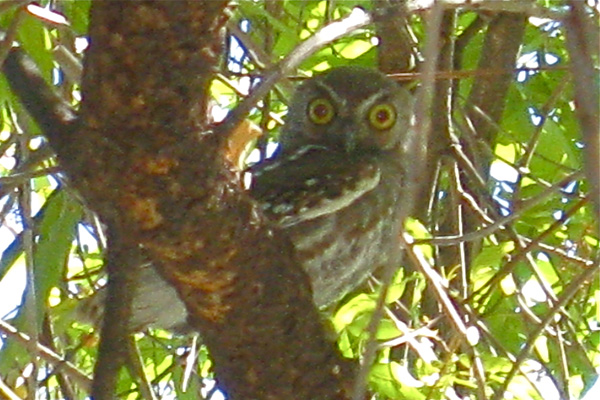 morning quiet, the back yard was chattering with angry bird sounds: MOB! Two Curve-billed thrashers, three cactus wrens, one Costa’s and two un-ID’d hummers, a verdin, a handful of Lesser goldfinch, and a couple of Gila woodpeckers, all shrieking in the upper branches of the messy African sumac right outside the bedroom door.
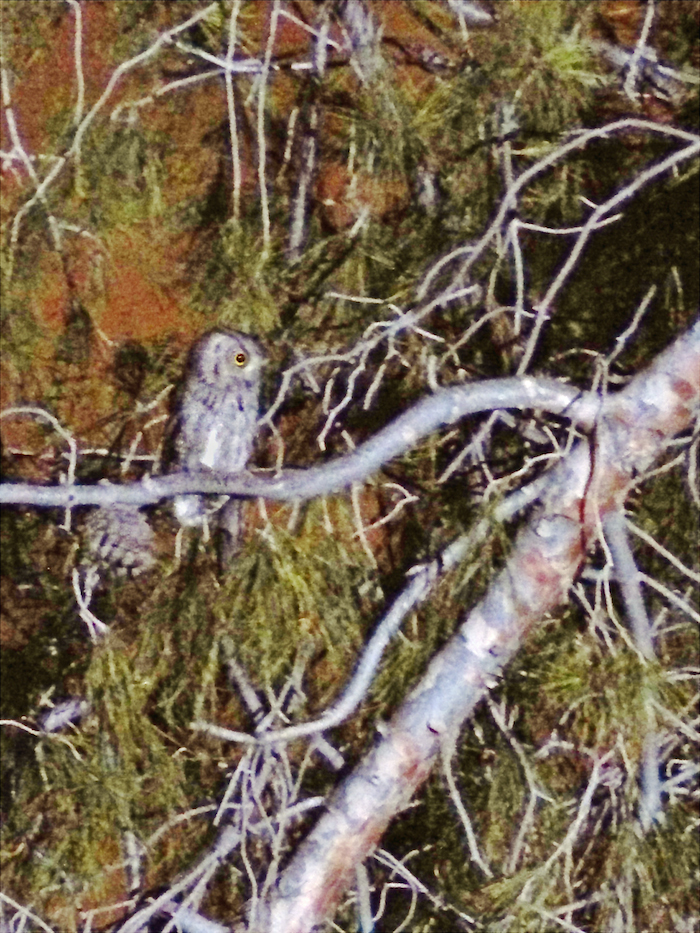
I stood under the canopy of snaggly twigs and miscellaneous branches for a while, with binox, until I saw the reason for their agitation: the Real Cranky Owlet. A tiny, tiny owl, with a round head, staring down on me with enormous outrage. I ran in to get binox and camera, and when I got back outside, it was sitting there still radiating high dudgeon.
It took a bit of hunting to find a window through the leafy snarl, but I finally got the owl in clear view. At first I thought: it’s a recently fledged Western Screech Owl, too young for cranial 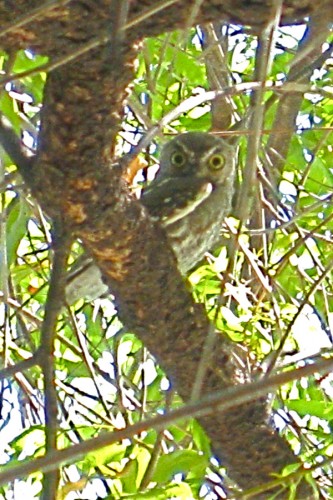 tufts (ie, “ears”), wedged up in the twigs, trying to pretend it hadn’t been spotted by half the shouting avifauna of the yard, and one quarter of the interior mammals. I’d recently been hearing a WESO calling at night in the yard, and we get them around here occasionally (well, they’re probably here all the time, but we hear or see them occasionally). It was a likely candidate.
<< radiating high dudgeon
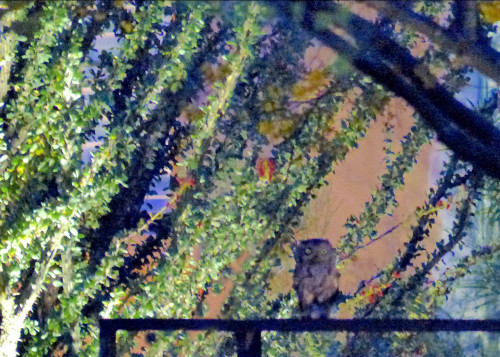
But… I looked again, without my binox: it was clearly not a screech owl — the bird was SO TINY! As any birder will tell you, size is one of the hardest characteristics to judge in the field, and an easy place to go wrong. Comparisons are invaluable. The thrashers mobbing it were considerably bigger than the owl; it was about the same size as the Cactus wrens, although in a vertical format, rather than horizontally arranged like the wrens; it was approximately sparrow-sized. There’s only one owl that dinky, in the desert or anywhere: the Elf owl (Micrathene whitneyi, en français chevêchette des saguaros, en español tecolotito anano). The supercilious white “spectacles”, the reddish blotches on the breast, the size of the eyes in the smallish head: it was an Elf owl in our yard! I was able to get a couple of poor snapshots — tough light to boot — which I’ve posted here, magnified.
Like the Western screech owls, Elf owls may be in the neighborhood regularly; we live in an “older” (by Phoenix standards) subdivision with naturalized desert landscape, including mature saguaros with woodpecker holes. But I hadn’t heard an Elf owl or seen one around here, and believe me, it wasn’t for not listening, or not looking in every saguaro hole I know about.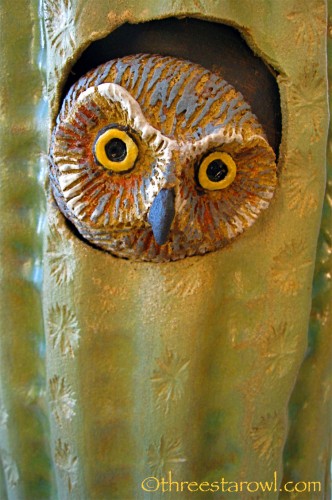 So, since the Elf Owl population in our part of the state is seasonal, it’s also possible that this individual could be a migrant, moving out of its breeding area to its wintering zone, passing through our yard.
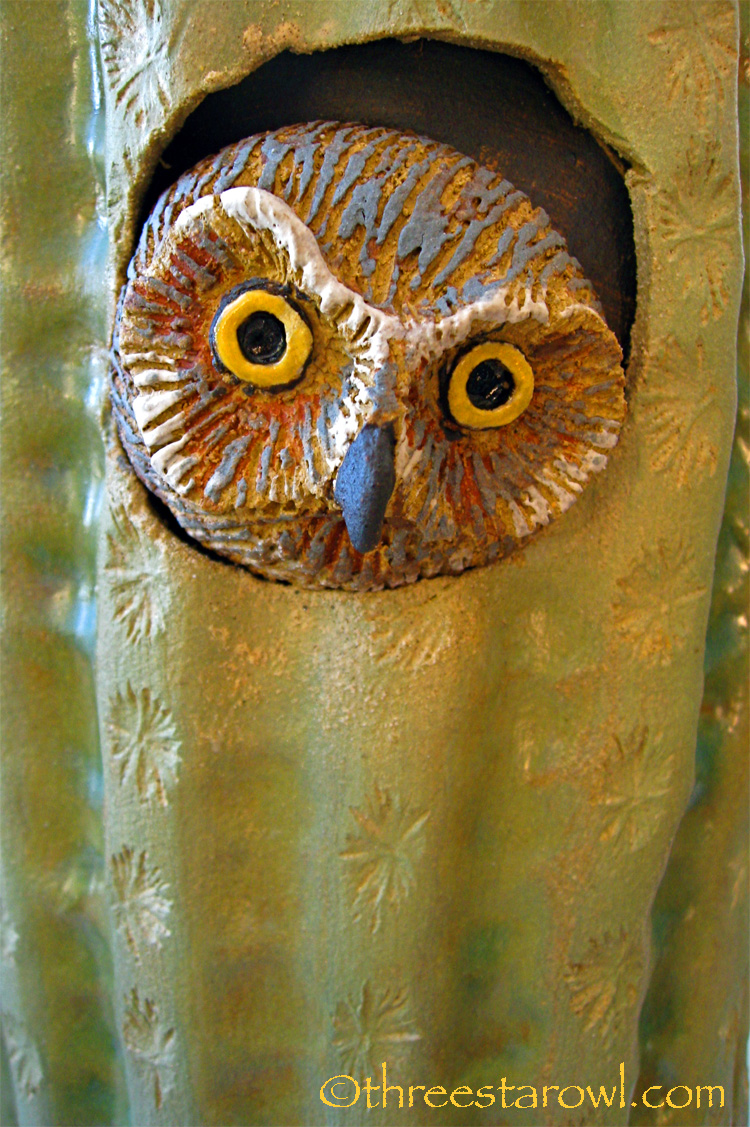
detail, Elf owl in saguaro vase (Allison Shock Three Star Owl, stoneware, 14″) >>
The sumac probably seemed like a good day roost. But, unfortunately, it turned out there were not only hecklers, but a paparazza, and the tiny owl flew a few yards to lose itself in the denser, thorny canopy of the nearby Texas Ebony. The hecklers followed, but I didn’t. (All photos A.Shock)
The yard’s been hopping, recently. Click here to read an assortment of posts about what we see right outside our doors, birds and other things.


 [Updated 6 July 2014: I understand the urge to point out that spiders don’t chase people in swimming pools — the scenario seems unlikely, I agree. But with a gremlin looking on, who knows what curious occult forces were at work? Better?]